1:24 Scale vs 1:32 Scale: Which Is Bigger?
1:24 scale is larger than 1:32 scale. For the same real car, a 1:24 model is about one-third larger in linear size, so a 20-foot car scales to about 10 inches in 1:24 versus about 7.5 inches in 1:32. That gap changes shelf fit, display case spacing, and track choices. This guide compares them with exact car-length examples and gives a simple rule for display and slot-car buyers.
| Factor | 24 scale | 1 | Winner |
|---|---|---|---|
| Overall size | Bigger; 1 unit on the model equals 24 units on the real car, so it is larger in every linear dimension. | Smaller; 1 unit on the model equals 32 units on the real car. | 24 scale |
| Typical model length | Common passenger cars are about 7 to 10 inches long, with pickups and vans often about 10 to 12 inches. | Common cars are about 5.25 to 7.5 inches long, with pickups and larger vehicles near 8 to 9 inches. | 1 |
| Display footprint / shelf fit | Takes more shelf space and needs more internal bay depth and more space between rows. | Smaller footprint; easier to fit in tighter spaces, narrower cabinets, and denser rows. | 1 |
| Detail visibility | Details such as grilles, wheels, mirrors, and interior pieces are easier to see from desk distance; clearer body detail and more presence. | Less visual presence than the larger scale. | 24 scale |
| Collector display use | Works well when you want the car to be the focal point on a desk, a single shelf, or a small themed display. | Better when the case is shallow, narrow, or already crowded. | Tie |
| Slot-car / layout fit | The article does not present 24 scale as the common slot-car scale. | A common slot-car scale with practical advantage for layout design; better for tighter rows and easier cabinet spacing. | 1 |
| Use when storage space is limited | Needs more depth, more shelf width per car, and more space between rows. | Fits more cars in the same space and leaves more room for labels, figures, or a second row. | 1 |
| Best-fit use | Best if you want more presence, clearer body detail, and a model that reads well from close range. | Best if you want to fit more cars in the same space or build a slot layout with compact size. | Tie |
Quick answer
1:24 is bigger. One unit on the model equals 24 units on the real car. In 1:32, one unit equals 32 units. That makes 1:24 the larger model in every linear dimension, so it takes more shelf space and usually reads more strongly at a glance.
From the same real car, the 1:24 model is 33.3% longer, wider, and taller than the 1:32 version. The difference is even larger by volume, which is why the same car body looks and feels much more substantial in 1:24. These ratio conversions follow standard scale math: model size equals real size divided by the denominator in the scale ratio.
Scale length comparison table
This table turns common real-car lengths into approximate model lengths. Use it to judge fit for a shelf, case, or slot layout before you buy.
| Vehicle type | Typical real length | 1:24 model length | 1:32 model length |
|---|---|---|---|
| Small car | 14 ft | 7.0 in | 5.25 in |
| Small sedan | 15 ft | 7.5 in | 5.6 in |
| Midsize sedan | 16.5 ft | 8.25 in | 6.2 in |
| Sports coupe | 18 ft | 9.0 in | 6.75 in |
| SUV | 19 ft | 9.5 in | 7.1 in |
| Full-size car | 20 ft | 10.0 in | 7.5 in |
| Pickup truck | 21 ft | 10.5 in | 7.9 in |
| Long truck or van | 24 ft | 12.0 in | 9.0 in |
Say your shelf is 36 inches wide and you want three full-size cars in one row. Three 1:24 models at 10.0 inches each already use 30 inches before any spacing. Three 1:32 models at 7.5 inches each use 22.5 inches, which leaves more room for mirrors, gaps, and a clean border at the edge.
How big is 1:24 scale?
1:24 scale is large enough that common passenger cars usually land around 7 to 10 inches long, with pickups and vans often closer to 10 to 12 inches. Because the models are physically larger, details such as grilles, wheels, mirrors, and interior pieces are easier to see from desk distance. The exact length depends on the real vehicle length, which is why scale math matters more than body style alone.
Typical model length by vehicle type
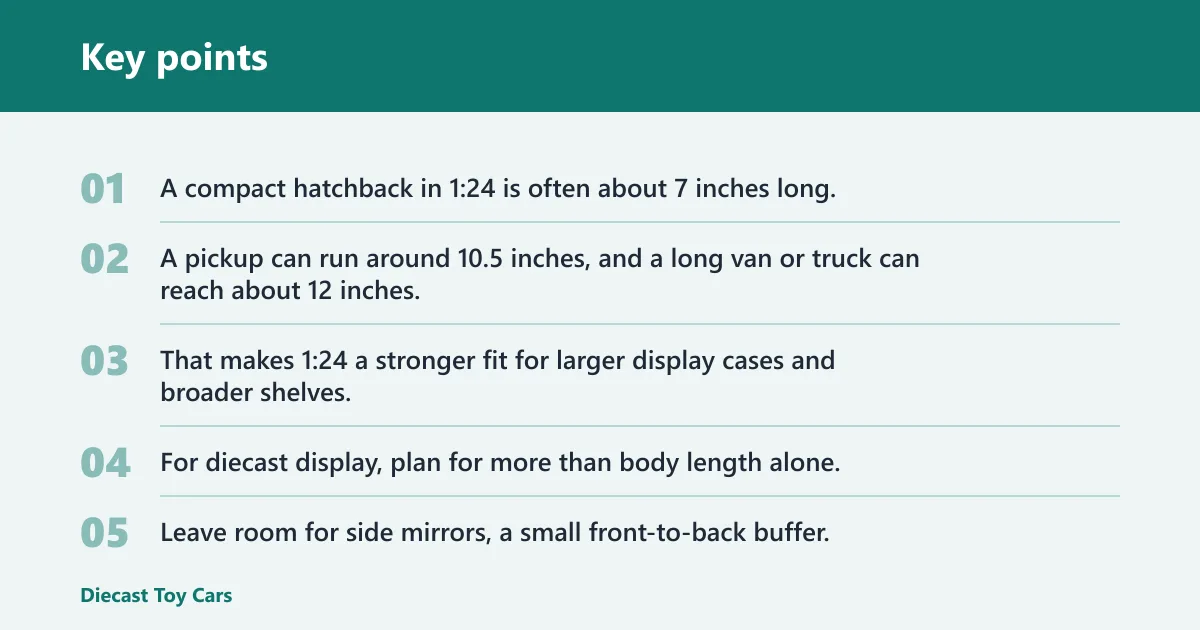
A compact hatchback in 1:24 is often about 7 inches long, while a full-size sedan is closer to 10 inches. A pickup can run around 10.5 inches, and a long van or truck can reach about 12 inches. That makes 1:24 a stronger fit for larger display cases and broader shelves.
Display footprint for diecast cars
For diecast display, plan for more than body length alone. Leave room for side mirrors, a small front-to-back buffer, and enough vertical clearance for roof details or antennas. A cabinet that fits a 10-inch model needs extra depth beyond 10 inches, or the nose and tail will sit too close to the glass or back panel.
Collector use cases for 1:24
1:24 works well when you want the car to be the focal point on a desk, a single shelf, or a small themed display. It also suits collectors who care about body detail and want enough size to read paint, badging, and interior pieces without moving the model around much.
How big is 1:32 scale?
1:32 scale is smaller and easier to place in tighter spaces. Common cars in 1:32 often land around 5.25 to 7.5 inches long, with pickups and larger vehicles near 8 to 9 inches. That smaller footprint is the main reason many collectors use it for denser shelves and slot-car layouts.
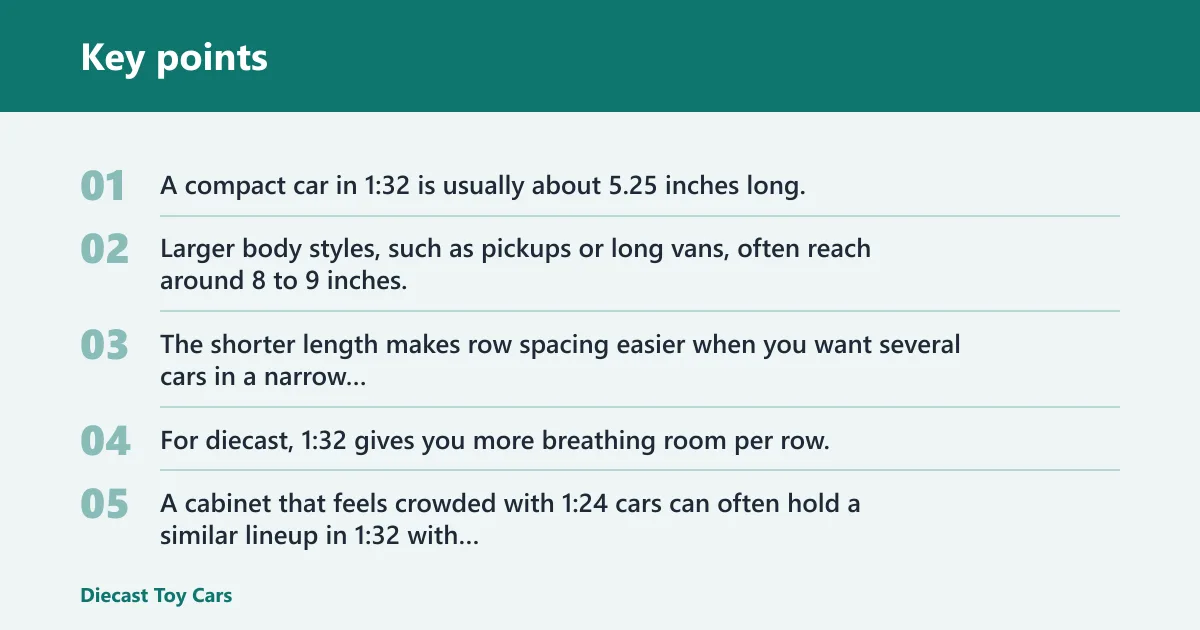
Typical model length by vehicle type: a compact car
A compact car in 1:32 is usually about 5.25 inches long, while a full-size car is roughly 7.5 inches. Larger body styles, such as pickups or long vans, often reach around 8 to 9 inches. The shorter length makes row spacing easier when you want several cars in a narrow cabinet.
Display footprint for diecast cars: for diecast, 1:32 gives
For diecast, 1:32 gives you more breathing room per row. A cabinet that feels crowded with 1:24 cars can often hold a similar lineup in 1:32 with cleaner spacing between mirrors and body sides. Height clearance still matters, but length is usually the first limitation you solve.
Slot-car context and layout fit
1:32 is also a common slot-car scale, so it has a practical advantage for layout design. As a general rule, lane spacing, guide clearance, and the exact track system matter more than the scale label alone. For slot-car buyers, confirm the manufacturer’s published track dimensions and vehicle compatibility before ordering, because lane center and power details vary by product line.
There is also power variation by product line, so check the exact slot-car system and the manufacturer listing for your model. Published specs are the safest reference for voltage and controller compatibility.
Display case and shelf fit
For display cases, the useful measurement is internal clearance, not just the stated exterior size. Start by allowing extra length beyond the model itself, then add room for mirrors, wheelbase overhang, and a little hand clearance for placing and removing the car. If your goal is a tidy presentation, the display case should also leave enough depth for the car to sit centered, not pressed against the front or back panel.
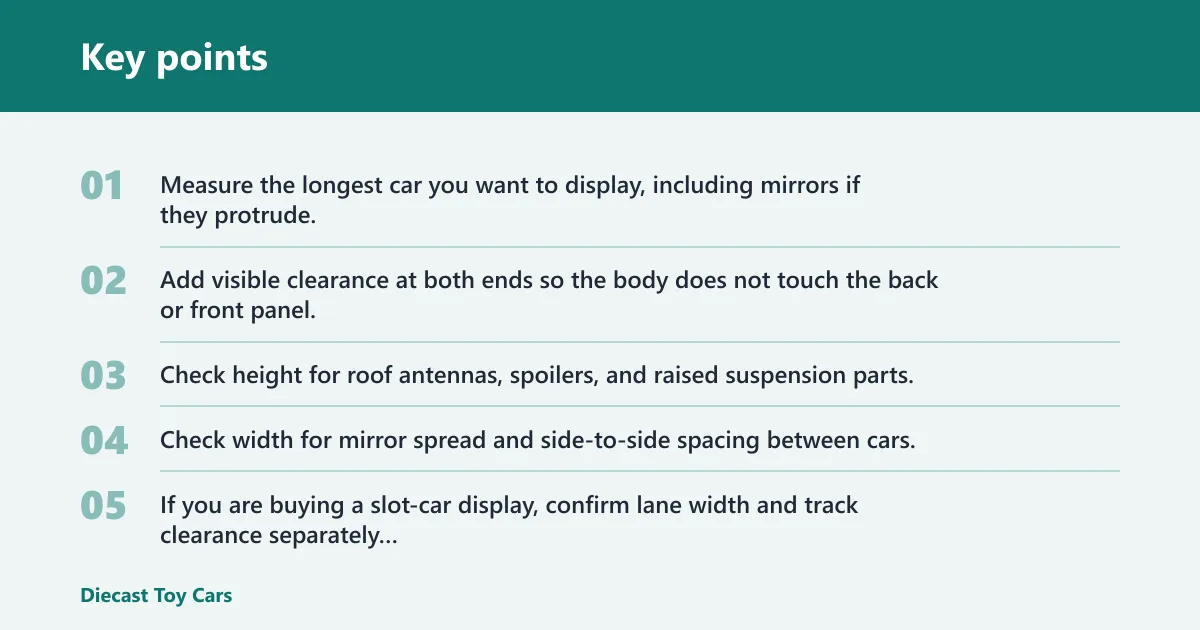
- Measure the longest car you want to display, including mirrors if they protrude.
- Add visible clearance at both ends so the body does not touch the back or front panel.
- Check height for roof antennas, spoilers, and raised suspension parts.
- Check width for mirror spread and side-to-side spacing between cars.
- If you are buying a slot-car display, confirm lane width and track clearance separately from the cabinet size.
For most common cars, a 1:24 model needs a longer internal bay than a 1:32 model of the same vehicle. The same real car may fit both scales, but 1:24 needs more depth, more shelf width per car, and more space between rows if you want the lineup to look tidy.
Picture a 20-foot sedan on a shelf with four other cars nearby. In 1:24, each car is about 10 inches long, so the row fills quickly. In 1:32, each one is about 7.5 inches long, which leaves more room for labels, figures, or a second row behind the first.
Choose 1:24 if… / Choose 1:32 if…
Choose 1:24 if you want more presence, clearer body detail, and a model that reads well from close range. Choose 1:32 if you want to fit more cars in the same space, keep a smaller footprint per model, or build a slot layout that uses tighter rows and easier cabinet spacing.
- Choose 1:24 if your shelf is wide and you want each car to stand out.
- Choose 1:24 if you prefer larger models for inspection of paint, trim, and interior details.
- Choose 1:32 if your case is shallow, narrow, or already crowded.
- Choose 1:32 if you are planning a slot-car layout where compact size and layout fit matter more than visual presence.
A common first-timer mistake is choosing a model by the character name alone and not by the scale, even though a 1:24 version will be noticeably larger than a 1:32 one. A 1:24 pickup can be longer than many 1:32 SUVs, so the body style does not tell you the final footprint. Compare the scale ratio and the model length before you buy a case or redesign a shelf.
Which scale is bigger?
1:24 is bigger than 1:32. That is true in every linear dimension, so the 1:24 model is longer, wider, and taller for the same real car. If you want the larger display piece, 1:24 wins; if you want easier fit and denser storage, 1:32 wins.
Frequently asked questions
How big is a 1:24 scale car in inches?
A 1:24 scale car is usually about 7 to 12 inches long, depending on the real vehicle. A compact car can land near 7 inches, a full-size sedan near 10 inches, and a pickup or van near 10.5 to 12 inches. Width and height scale the same way.
How big is a 1:32 scale car?
A 1:32 scale car is usually about 5.25 to 9 inches long, depending on the real vehicle. Small cars are near 5.25 to 6.2 inches, standard sedans around 7.5 inches, and larger pickups or vans closer to 8 to 9 inches. It is the smaller of the two scales here.
What is 1:24 scale?
1:24 scale means 1 unit on the model equals 24 units on the real car. In practical terms, every inch on the model equals 24 inches on the real vehicle. That makes it a larger model scale with more visual presence and a larger display footprint.
What is 1:32 scale?
1:32 scale means 1 unit on the model equals 32 units on the real car. Every inch on the model equals 32 inches on the real vehicle. Because the ratio is larger, the finished model is smaller than the same car in 1:24 scale.
What scale should I choose for a display or track setup?
Choose 1:24 if your priority is size, detail visibility, and a stronger shelf presence. Choose 1:32 if your priority is saving space, fitting more cars in one cabinet, or working within a compact slot-car layout. For track buyers, confirm the exact lane centers and system compatibility before ordering.
Which scale is bigger, 1:24 or 1:64?
1:24 is bigger than 1:64. The smaller the denominator, the larger the model. So 1:24 will always take more space than 1:64 for the same real car, with a much larger body length and a stronger display footprint.
1:24 vs 1:18 and 1:24 vs 1:64
1:24 is smaller than 1:18 but larger than 1:64. Use 1:18 when you want the biggest common diecast presence, and use 1:64 when you want the smallest, most space-saving option. If you are choosing between several scales, the simple rule is that a smaller denominator means a larger model.
Sources
- Scale ratio math based on standard proportional conversion: model dimension = real dimension ÷ scale denominator.
- Common diecast length examples are approximate conversions from typical vehicle lengths, rounded for display planning.
- Slot-car sizing and power details vary by manufacturer and product line; confirm published specs before purchase.