Diecast Car Scale Comparison: 1:18 vs 1:24 vs 1:64
For most collectors, 1:18 gives the most detail, 1:24 splits detail and space, and 1:64 keeps cost and bulk low. Choose the scale that fits your shelf space, budget, and how many cars you want to display. Pick the wrong one, and you can waste shelf length, overspend on duplicates, or end up with models that feel too plain for the money. This guide compares detail, footprint, and cost so you can choose the right scale for your collection.
What diecast scale means
Diecast scale is the model-to-real-car ratio. A 1:24 model is one twenty-fourth the size of the actual vehicle, so the smaller the second number, the larger the model. That is why 1:18 cars are bigger than 1:24, and 1:64 cars are generally the smallest of the three main collector scales.
Reading a box is simple once you know the ratio. If a listing says 1:18, the model is built at one eighteenth of full size. If it says 1:64, the car is much smaller and usually built for lower cost, denser storage, and more casual handling.
Common brands help set expectations. 1:18 often appears in higher-end lines from larger diecast makers; 1:24 is commonly sold by collector-focused brands and mainstream toy lines; 1:64 is also a common scale for many modern collector brands that emphasize very fine printing and detailed castings.
Diecast scale comparison table
| Criterion | 1:18 | 1:24 | 1:64 |
|---|---|---|---|
| Typical model length | 10–12 inches | 7–9 inches | 2.5–3 inches |
| Estimated shelf footprint per 10 cars | About 100–120 inches of linear shelf length | About 70–90 inches of linear shelf length | About 25–30 inches of linear shelf length |
| Relative cost tier | Highest | Middle | Lowest |
| Detail level | High, often with opening doors, hoods, trunks, and detailed interiors | Good detail with less bulk than 1:18 | Varies widely; from basic to highly detailed modern collector issues |
| Best use case | Centerpiece displays and feature cars | Balanced collecting and display | Bulk collecting, dioramas, and large variety sets |
| Common mistake to avoid | Buying before checking cabinet depth | Assuming it will match 1:18 detail at lower cost | Expecting every 1:64 model to feel premium |
The table shows the real tradeoff: bigger scale gives you more visible detail, but it also eats shelf length fast. Ten 1:18 cars can take about four to five times the linear shelf room of ten 1:64 cars. That difference matters more as a collection grows.
How big is 1:18 vs 1:24 vs 1:64?
1:18 models are typically 10–12 inches long, 1:24 models are typically 7–9 inches long, and 1:64 models are typically 2.5–3 inches long. That spread sounds abstract until you place them on a shelf, where depth, height, and the room needed between models start to matter.
Display depth and spacing
1:18 cars need the most breathing room. Doors and hoods may open, mirrors and spoilers can stick out, and many collectors want enough gap to keep the model from looking crowded. A shallow bookshelf that works for smaller scales can feel cramped very quickly with 1:18.
1:24 is easier to place on standard shelving. It still needs care, but the shorter length makes it simpler to line up several cars without turning your display into a tight parking lot. 1:64 needs the least room and can fit in drawers, display cases, and multi-row dioramas where larger scales would be impossible.
Picture a collector with a 36-inch shelf. Three 1:18 cars may already feel crowded once you include spacing, while the same shelf can hold a far larger number of 1:64 models in neat rows. That is why collection growth changes storage needs so quickly.
Cabinets, desks, and wall shelves
Desk displays favor 1:24 and 1:64 because they are easier to stage around monitors, lamps, and everyday clutter. Wall shelves can hold 1:18, but only if the shelf depth is generous and the mounting is sturdy enough for heavier models. For compact apartments or shared rooms, 1:64 usually gives the most freedom.
Which diecast scale gives the best detail for the money?
1:18 usually gives the strongest raw detail, but that does not mean it always gives the best detail for the money. For some collectors, 1:24 is the smarter buy because it captures a lot of visible detail without the higher price and larger footprint of 1:18.
Why 1:18 often looks the most complete
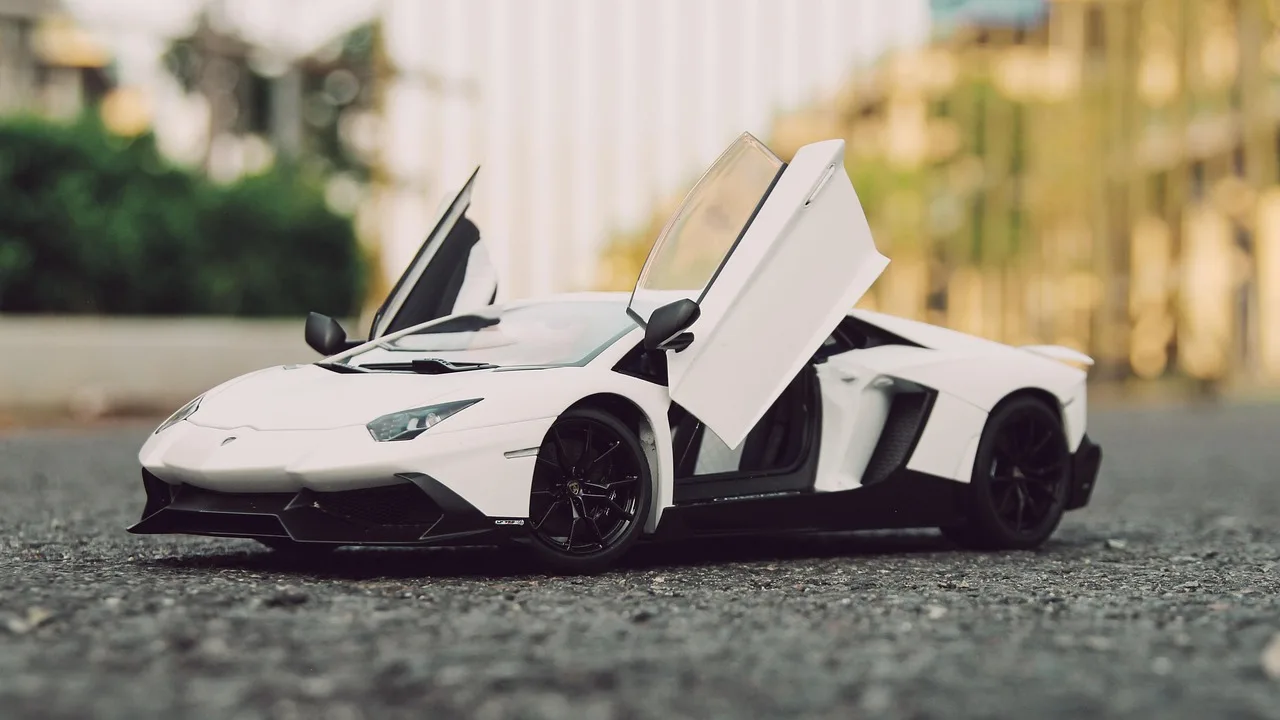
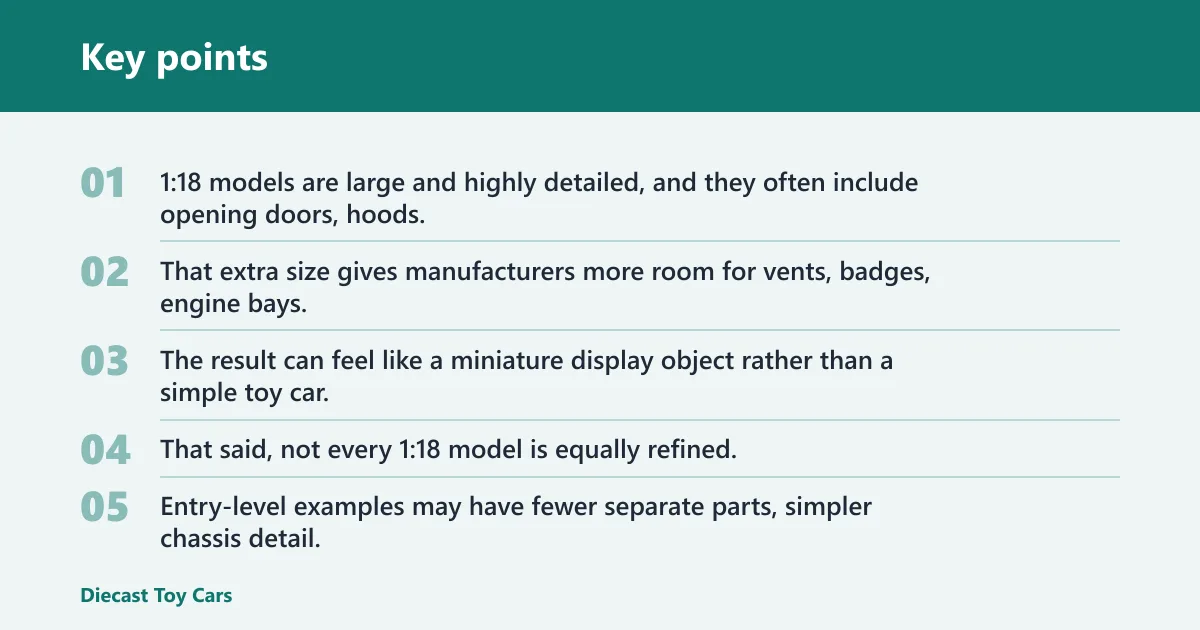
1:18 models are large and highly detailed, and they often include opening doors, hoods, trunks, and detailed interiors. That extra size gives manufacturers more room for vents, badges, engine bays, and suspension pieces that would be hard to express at smaller scales. The result can feel like a miniature display object rather than a simple toy car.
That said, not every 1:18 model is equally refined. Entry-level examples may have fewer separate parts, simpler chassis detail, or softer paint execution than premium releases. So the scale helps, but the line and manufacturer still matter.
Why 1:24 can be the better value
1:24 offers a balance of detail and affordability. It is also the most popular size for collectors, which helps explain why so many buyers use it as a default scale when they want good shelf presence without the size penalty of 1:18. For the same car, 1:24 can be the better buy when space or budget caps the collection.
Say your display budget covers one premium model now and several more later. A 1:24 release may let you buy a wider range of cars in the same theme, while 1:18 could force you to choose only one or two pieces. That tradeoff matters if you want variety more than one oversized centerpiece.
Why modern 1:64 can surprise collectors
1:64 is affordable and easy to collect in bulk, but it is no longer limited to simple play-focused models. Modern premium 1:64 releases can include sharp tampo printing, rolling-accurate wheels, and well-specified castings that appeal to serious collectors. The catch is that detail is still constrained by size.
That means 1:64 can deliver excellent value, but not every release will feel comparable to a good 1:18 or 1:24 model. If you choose 1:64 expecting the same physical depth, opening parts, and interior drama as a larger scale, disappointment is likely.
Which scale fits your space and budget?
The right scale depends on what you collect, how much room you have, and how often you want to expand. Display-first collectors usually prefer 1:18, mixed collectors often settle on 1:24, and volume-driven buyers tend to prefer 1:64 because it stretches both shelf space and budget.
Display-first collectors
If you want a few standout models, 1:18 is the strongest fit. It suits centerpiece displays, supercars, classics with opening panels, and models where interior and engine detail matter. The tradeoff is that each purchase consumes more room and more money, so the collection grows slowly.
Bulk buyers and set builders
If you want to build a theme quickly, 1:64 is the practical choice. It works well for color runs, police fleets, muscle-car sets, and road scenes in dioramas. You can collect a lot of variety without turning storage into a problem.
Gift buyers and casual collectors
1:24 is often the safest gift choice because it feels substantial without being cumbersome. It is large enough to impress, small enough to store, and usually easier to fit into a collection without special shelving. If you do not know the recipient’s exact display setup, 1:24 is a sensible middle path.
Why collectors choose 1:18, 1:24, or 1:64
Collectors choose 1:18 when the car itself is the display piece. They choose 1:24 when they want a strong balance of footprint, price, and visible detail. They choose 1:64 when volume, variety, and easy storage matter more than sheer size.
Common failure cases are easy to spot. A collector buys 1:18 and then discovers the cabinet is too shallow for mirrors and roof spoilers. Another collector buys 1:64 expecting premium presence, then realizes the model is meant for density and quantity, not big display drama.
Why some collectors move from 1:18 to 1:24
1:24 can be the better choice when the subject matter is the same but the room is not. If two versions of the same car exist, 1:24 may preserve enough detail while freeing space for more models. That is a practical win when shelves are already crowded.
A common first-timer mistake is choosing a 1:18 diecast because it looks impressive online, then discovering the shelf spacing in the home office only leaves room for a single car per tier. The scale was the problem, not the car.
Why 1:64 is serious collecting, not only kids’ toys
1:64 is a serious collector scale because many buyers value theme breadth, rare variants, and diorama potential over size. Hot Wheels and Matchbox made the scale familiar, but modern collector releases have pushed it into a more detailed and more curated space. Serious collecting is possible when the buyer knows what the scale is meant to do.
Verdict: 18 or 1?
Choose 18 if you want centerpiece displays and feature cars with opening doors, hoods, trunks, and detailed interiors, especially when the car itself is meant to be the display piece.
Choose 1 if you want bulk collecting, dioramas, and large variety sets, or need the lowest cost and least shelf space for color runs, police fleets, and road scenes.
Frequently asked questions
What is the difference between 1:18, 1:24, and 1:64 diecast cars?
The difference is the scale ratio. 1:18 models are the largest of the three, 1:24 sits in the middle, and 1:64 is the smallest. Larger scales usually allow more visible detail and opening parts, while smaller scales make it easier to collect in volume and use less shelf space.
How big is a 1:18 diecast car compared with 1:24 and 1:64?
1:18 models are typically 10–12 inches long, 1:24 models are typically 7–9 inches long, and 1:64 models are typically 2.5–3 inches long. That gap affects display depth as much as length, especially when mirrors, spoilers, and open panels need extra clearance.
Which diecast scale is easiest to store and display?
1:64 is the easiest to store and display because the models are small and can be grouped densely. 1:24 is the next easiest, especially on standard shelves and desk displays. 1:18 needs the most depth and spacing, so it is the hardest to fit into tight cabinets.
Is 1:24 diecast the best all-around scale for collectors?
For many collectors, yes, because 1:24 balances size, cost, and detail better than the other two main scales. It is not the right answer for every buyer, though. Display-first collectors may still prefer 1:18, and volume collectors may get more satisfaction from 1:64.
Is 1:64 diecast good for serious collectors or just kids?
1:64 is absolutely good for serious collectors. It supports large themes, rare variants, and detailed modern releases, including the Hot Wheels and Matchbox side of the hobby. The difference is that you are collecting with density and variety in mind, not oversized presentation.