
How to Choose a Diecast Car Storage Case for 1:18 Models
Choose a 1:18 storage case by the car’s actual exterior dimensions, then add clearance for mirrors, spoilers, and retrieval. Advertised “fits 1:18” labels can miss protrusions and base thickness, which is why a tight shelf can rub paint or make removal awkward. Careful measuring and safe handling both matter.
Quick answer: measure the model’s longest, widest, and tallest points; compare those numbers with the case’s inside depth, shelf height, and opening width; then require a pass on all three. For most collections, sports cars fit with modest extra clearance, sedans need a little more, and SUVs or modified models need the most retrieval clearance.
Start with the model’s real footprint
Measure the largest car first, not the average one. A compact sports car, sedan, and SUV can need very different space at the same scale, and a modified model can need even more because mirrors, wings, antennas, roof racks, open doors, or a raised engine cover change the usable envelope. In practice, the real footprint is what matters; scale labels are only a starting point.
Measure length, width, and height
Use the model’s outermost points, not the catalog name. Length is the full nose-to-tail span, width includes mirrors if they stay attached, and height should include any spoiler or roof detail that sits above the roofline. If a door opens outward, treat that as part of the clearance problem too.
Add clearance for protrusions
A shelf that matches the body shell can still fail at the accessories. Leave room for mirror tips, rear wings, and antennas, because they are the parts most likely to touch a side wall or the shelf above. If the car will sit in a tight row, use the widest point as the deciding number. For safe case fitting, the clearance must protect both the object and the person removing it.
Separate static models from modified models
Static models are easier to place because their doors and hoods stay closed. Modified models need more room in every direction. A low sports car may fit a shallow case, while a tuned version with a tall rear wing or open bonnet may need a deeper shelf and more vertical space. Winged or door-open models are the common failure case because the “at rest” footprint understates the retrieval envelope.
What size storage case do I need for 1:18 diecast cars?
You need a case whose internal size fits the largest model plus retrieval clearance. For most 1:18 buyers, usable shelf depth is the first number to check, because it matters before the exterior finish. Depth must allow the car to sit fully on the shelf and still come out without scraping the back wall. That rule is more reliable than a scale label because actual 1:18 bodies vary by manufacturer and subject.
Minimum internal depth for 1:18 models
Measure from the inside back surface to the inside front edge. That is the usable shelf depth. Add room for fingers or a pull-out angle, especially if the case has a lip or a door frame. A shelf that looks deep enough from the outside can still be too shallow once the front trim is counted. Manufacturer manuals for shelves and cabinets usually define capacity by internal support span and permitted load, not by exterior dimensions alone.
As a practical rule, start with the model’s full length and add extra clearance for standard bodies. Use more clearance when mirrors, splitters, or rear wings extend beyond the shell. That is why a seller saying “fits 1:18” is not enough. A tighter sizing matrix works better than a blanket allowance:
Typical 1:18 sizing matrix: sports cars often need a little extra length; sedans usually need more; SUVs often need still more; winged, widebody, or door-open models usually need the most depth and extra height above the highest point. This is a display-fit rule, not a scale rule.
Vertical clearance for tall subjects
Height matters as much as depth. Spoilers, roof gear, aerials, and open panels can reach the shelf above, leaving a scuff mark or forcing you to tilt the model during removal. Give tall subjects extra headroom so the next shelf does not become a contact point. Museum case guidance treats overhead clearance as part of safe handling, especially where objects are removed repeatedly.
Picture a 1:18 SUV with a roof rack and side mirrors. It may clear the shelf when parked, but if the case has a low upper panel, you may have to angle the model forward to remove it. That can be enough to catch a mirror on the frame. The common failure case is not the parked fit; it is the exit path.
Shelf spacing for safe removal
Retrieval clearance is separate from display clearance. A shelf that only fits the car at rest can still be annoying if the door swing or slide opening does not leave enough room to lift the model out. Leave enough space to grasp the base or body without pressing against nearby models. Good practice is to treat “remove without contact” as the real pass condition.
- Measure the longest model in the collection.
- Measure the widest point, including mirrors if they stay attached.
- Measure the tallest point, including spoilers and roof parts.
- Check the inside shelf depth, not the outside cabinet size.
- Check the opening path for the door or sliding panel.
- Confirm there is room to remove the model without moving its neighbors.
Choose the right door style
Opening path is a key buying factor for display access. Front-opening doors work well when you want fast access without lifting a top panel. Sliding panels suit tight rooms, but they can reduce the clear opening width. Lift-off fronts or lids are simple, though they need an open area to set the panel aside. The best door style is the one that preserves safe retrieval clearance, not just one that closes neatly.
Front-opening doors
Front-opening designs are often the easiest for frequent rearranging. They let you reach straight in, which helps when models sit in two rows or when the shelf is crowded. Check hinge clearance before you buy, because a door that swings outward may hit nearby furniture or force the case away from the wall. Manufacturer installation guides commonly warn that swing space and wall spacing must be planned before anchoring or loading the cabinet.
Sliding panels
Sliding panels save swing space, but they can reduce access to the middle of the shelf opening. That matters if you keep models close together or if one car has mirrors that sit near the front frame. Choose sliding doors when room clearance is tight and the shelf layout is already shallow.
Lift-off access
Lift-off fronts or tops are simple, but they are less convenient for regular rearranging. They work better when the case stays in one place and the collection changes rarely. If you plan to move models often, a lift-off panel can become a nuisance because every access requires a full removal step. For frequent handling, the best case is the one that minimizes contact during entry and exit.
Diecast storage case checklist
Use this checklist to match the case to the model type. Check internal depth, shelf height, opening space, and width against the actual car, then compare those numbers with the table. A sports car can pass in a shallower case, while an SUV or modified model often needs more depth, height, and width. Keep the largest model in mind, and treat any single failed check as a no-go.
| Model type | Minimum internal depth | Minimum shelf height | Door-opening clearance | Safe shelf count | Notes for mirrors/wings/doors |
|---|---|---|---|---|---|
| Sports car | Body length + 20 mm | Body height + 10 mm | At least 60 mm front opening space | 1 row; 2 rows only on deep shelves | Pass if mirrors clear the side wall and the rear wing does not touch the shelf above |
| Sedan | Body length + 20 mm | Body height + 15 mm | At least 70 mm front opening space | 1 row for easy access | Pass if side mirrors can clear during removal without sliding adjacent cars |
| SUV | Body length + 25 mm | Body height + 20 mm | At least 80 mm front opening space | 1 row preferred | Pass if roof racks, antennas, and taller mirrors have headroom |
| Modified model | Body length + 30 mm | Highest point + 20 mm | At least 90 mm front opening space | 1 row; avoid crowding | Pass only if wings, open doors, or raised engine covers do not touch the frame |
Pass/fail rule: if any one of the three fit checks fails, the case is too small for that model type. Do not accept a shelf that passes depth but fails height, or one that fits at rest but blocks retrieval.
How many 1:18 cars fit on one shelf?
Visible capacity can differ from maximum capacity. A shelf may hold more models than it can display well, especially if the cars sit close enough that mirrors, spoilers, or door handles overlap visually. For 1:18 models, crowding usually shows up before the shelf is physically full. Load limits also matter: shelf weight ratings and anchoring instructions should be followed before capacity is increased.

Visible capacity versus maximum capacity
Maximum capacity is the most that can be packed onto a shelf. Visible capacity is the number that still lets you see the shape of each car and remove it without moving the one beside it. Those numbers are rarely the same, and the gap grows as the models get larger. For collections meant to be handled often, visible capacity is the better number to optimize.
Spacing for display quality
One row is the safest choice for most 1:18 shelves. Two or three rows can work for smaller scales or deep shelves, but 1:18 models usually need more room to avoid contact and to preserve visibility. If mirrors are close enough to touch, the shelf is already too dense. A tight row arrangement may look efficient, but it increases the chance of rubbing and awkward removal.
A common first-timer mistake is lining up four 1:18 cars on a shelf that leaves only a few millimetres between them. The display looks full, but the second car from the front becomes hard to remove, and the outer mirrors start to brush the adjacent bodywork. That is a pass/fail problem, not just a style issue.
When to stop at fewer models
Stop early if access gets awkward. If you need to move two cars to remove one, the shelf is overpacked for everyday use. For collectors who rearrange often, fewer models per shelf usually gives better long-term results than squeezing in one more car. If your shelf plan changes, see how to calculate shelf weight safely before adding another row.
Do lighting and dust change the case you buy?
Yes. Lighting should reveal detail, not become the attraction, and dust control should reduce cleaning frequency rather than promise a clean room. Both factors affect material choice, door style, and shelf spacing. Strong glare, heat from direct light, and open gaps can all hurt the display experience. For protected displays, conservation guidance favors low UV exposure, low heat, and controlled reflections.
Glare and reflection control
Glossy cases and glass fronts can reflect room lights straight into the viewing angle. That can hide paint detail and make the display harder to read. If a case will sit near a bright lamp, look for a layout that places the light at an angle instead of directly in front of the cars. If you are planning lighting from scratch, pair the case with UV-safe display lighting for diecast models rather than harsh point sources.
Heat from direct light
Avoid harsh direct sunlight on the collection. Heat can build inside a closed case, especially near windows or bright fittings, and that is a problem for plastics, adhesives, and finishes. Museum and conservation sources consistently recommend limiting UV and strong visible light exposure for sensitive surfaces; for display plastics and painted diecast finishes, the safest approach is indirect, low-heat lighting and placement away from windows.
Dust gaps, vents, and seals
Dust control helps, but it does not remove every speck. Gaps around doors, vents, and panel joints still admit dust over time. A tighter case reduces cleaning, yet it should still allow safe access and enough airflow when heat could build up from lighting or a warm room. If dust is your main issue, also review how to clean diecast cars without damaging paint so cleaning stays gentle and infrequent.
Check weight limits and box storage
Large diecast models add up quickly in weight. That matters for glass shelves, wall-mounted units, and multi-shelf furniture. Follow manufacturer load limits and anchoring instructions, because a shelf that looks stable can still be overloaded once the cases and models are filled. Tempered glass is stronger than ordinary glass, but its use still depends on the maker’s stated thickness, support, and load rating.
Shelf loading limits and anchoring
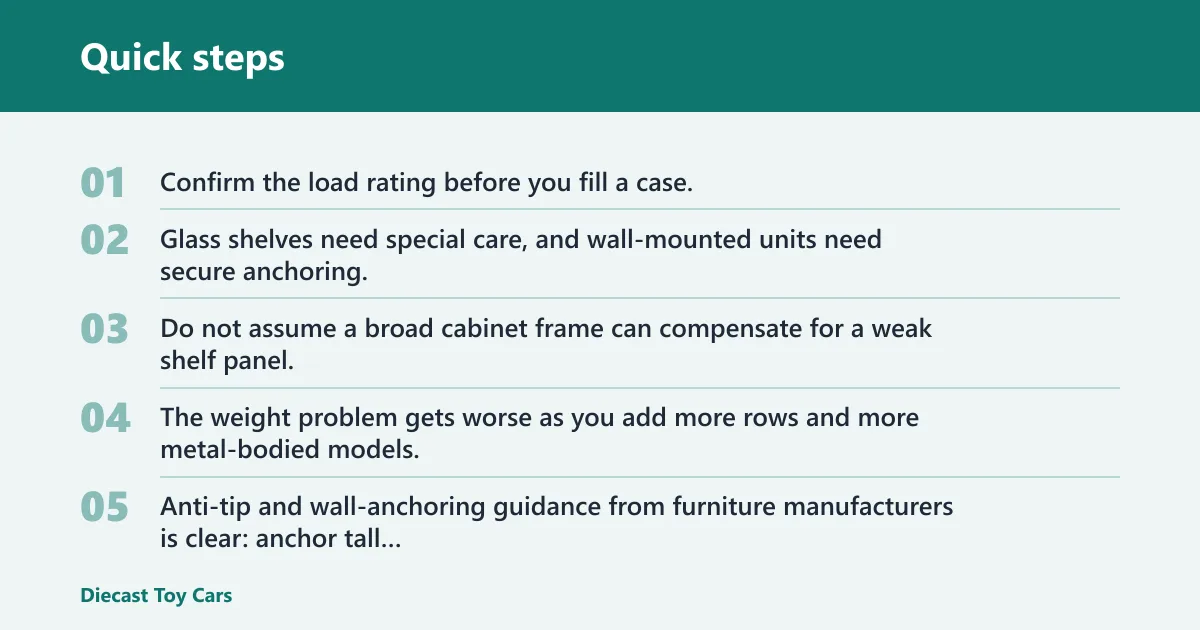
Confirm the load rating before you fill a case. Glass shelves need special care, and wall-mounted units need secure anchoring. Do not assume a broad cabinet frame can compensate for a weak shelf panel. The weight problem gets worse as you add more rows and more metal-bodied models. Anti-tip and wall-anchoring guidance from furniture manufacturers is clear: anchor tall or top-heavy units, distribute weight evenly, and do not exceed the rated load.
Glass shelves and wall-mounted units
Glass shelves can work well if the manufacturer approves the load and spacing. Wall units need proper fixings into a suitable wall structure, not just light-duty hardware. If the case will hang above furniture, choose extra caution; the stored weight is a safety issue as well as a display issue. For glass, follow the cabinet maker’s specific weight limit and support instructions.
Where to store original packaging
Plan the original boxes before you buy the case. The collection may occupy one wall while original boxes use a closet or another storage area. Boxes matter for resale and moving, but they are a separate storage problem. If you ignore them, the display case can solve one space issue and create another. For long-term storage, keep boxes dry, flat, and away from crushing loads, and separate them from the display area if that helps preserve both.
Suppose you buy a cabinet that fits twelve loose 1:18 cars, then discover the twelve boxes need an extra shelf elsewhere. The cars display well, but the packaging still takes up room, and the storage plan is incomplete. Decide on box storage first if you expect to keep the packaging. For practical organization, review original diecast box storage ideas before you finalize the case layout.
Frequently asked questions
How much internal depth should a 1:18 display case have?
As a starting point, use the model’s full length plus extra clearance. Add more if the front splitter, rear wing, or door shape makes removal harder. Measure the inside depth from back wall to front edge, because exterior depth can be misleading. If the model has protruding parts, size to the protrusions, not the body shell.
Should I choose front-opening, sliding, or lift-off doors?
Choose front-opening doors if you plan to access models often. Sliding panels suit tight spaces, but they can reduce the usable opening. Lift-off fronts or tops are fine for static displays, though they are less convenient when you rearrange cars frequently. The best choice is the one that preserves safe retrieval and does not force you to move neighboring models.
How many 1:18 cars should fit on one shelf without crowding?
For most shelves, one row is the safest choice. Two rows may work on deep shelves, but only if the back row stays visible and removable without moving the front row. If mirrors touch or removal becomes awkward, the shelf is too crowded. Capacity should be judged by access, not just by how many cars physically fit.
Do I need space for mirrors, wings, and open doors?
Yes. Mirrors, wings, antennas, roof racks, open doors, and raised engine covers can all change the real size of the model. Leave room for the widest and tallest points, not the body shell alone. That extra room prevents contact during both display and removal. It also reduces the chance of chipped paint and bent parts.
How do I keep dust off 1:18 diecast cars in a display case?
Use a case with fewer gaps around the doors and a layout that does not force frequent opening. Dust control reduces cleaning, but it is not perfect. Keep the case away from open vents and direct sunlight, and expect to wipe it down from time to time. Low-dust storage works best when paired with gentle cleaning habits and stable placement.
Is a glass shelf strong enough for 1:18 models?
Sometimes, but only if the shelf rating and anchoring instructions support the combined load. Large diecast models add up quickly in weight. Check the manufacturer limits for both the shelf and the whole unit, especially for wall-mounted cases or multi-shelf cabinets. Tempered glass helps with safety, but it does not replace the stated load limit.
What should I do with the original boxes if I buy a display case?
Set aside a separate storage area before you buy the case. Many collectors keep the cars on display and store the boxes in a closet, under-bed container, or other dry space. The display case does not solve box storage unless you plan for it in advance. If resale value matters, box storage should be part of the purchase decision.
How do I choose a display case if I rearrange models often?
Prioritize easy access over maximum capacity. Front-opening doors, one-row shelves, and extra removal clearance make rearranging much easier. If a shelf forces you to move neighboring models every time, the case is not a good fit for an active collection. Frequent rearranging is where retrieval clearance matters most.