
Where Can You Buy Display Cases for Diecast Cars?
Buy diecast display cases from the model brand’s own store for exact-fit protection, from specialist model retailers for scale-specific options, from marketplaces such as Amazon and eBay for rare or out-of-production cases, and from replacement-case suppliers when only the cover or base needs replacing. For example, Agora Models is a brand-store option, Elfershop is a specialist retailer, and Amazon or eBay are marketplace options. A poor fit can scratch paint, leave models loose, or crack the case during storage and shipping. This guide maps the best places to buy by use case and gives you a fit-risk checklist before you order.
Best places to buy display cases

Brand stores for exact-fit cases
Brand stores make the most sense when you already know the model family and want the case built around that shape. Agora Models lists a display case for its 1:8 scale cars, with external dimensions of 740 x 425 x 340 mm and internal dimensions of 690 x 375 x 310 mm.
That kind of listing helps when fit certainty matters more than browsing variety. It also cuts down on guesswork for collectors of large, fixed-scale builds, because the case dimensions are stated clearly and the model scale is tied to the product page.
Specialist diecast shops for scale-specific options
Specialist diecast retailers are the best middle ground for most collectors. They usually carry tabletop cases, wall displays, and accessories in more than one scale, so you can compare fit, finish, and mounting style without sorting through unrelated home-display products.
Elfershop, for example, lists a premium BBR display case with a red Alcantara base and 3mm scratch-resistant acrylic material. It also sells a wall display for 8 to 50 models in 1/43, 1/24, and 1/18 scales, plus a rotating display stand and a dust seal strip for glass-door cases.
Marketplace sellers for price and variety
Marketplaces are useful when you need an older model case, a one-off replacement, or a size that is no longer sold by the original maker. They are also where you are most likely to find mixed lots, used display boxes, and listings for niche formats such as carded Hot Wheels or NASCAR diecast packaging.
The tradeoff is higher return risk, and return policies vary widely by platform and seller. Seller photos may hide warping, cracked corners, cloudy acrylic, missing clips, or poor packaging. Check the stated internal dimensions, ask whether the case is flat-pack or assembled, and read the return policy before you buy.
Replacement-parts sellers for missing or damaged cases
Replacement-parts sellers are the right channel when the model itself is fine but the original cover, lid, or base is damaged. SAFE Collecting Supplies sells a lockable acrylic display curio cabinet and lists frameless acrylic display cases with 12, 20, and 24 compartments, which suits owners who need a cabinet for display rather than a one-to-one case replacement.
Replacement cases are often sold in plexiglas or acrylic material, and many are sized for common 1/43 models. That can be the cleanest fix when the original case is yellowed, split, or missing after storage.
Which buying channel fits your model?
Match the channel to the model type, the risk you can accept, and how exact the fit needs to be. Brand stores are strongest for exact-fit cases. Specialist shops are best for collectors who want scale choices and clearer product specs. Marketplaces suit rare replacements. Replacement-parts sellers fit damaged or missing original cases.
Use cases for 1:18, 1:24, 1:43, and 1:64 cars
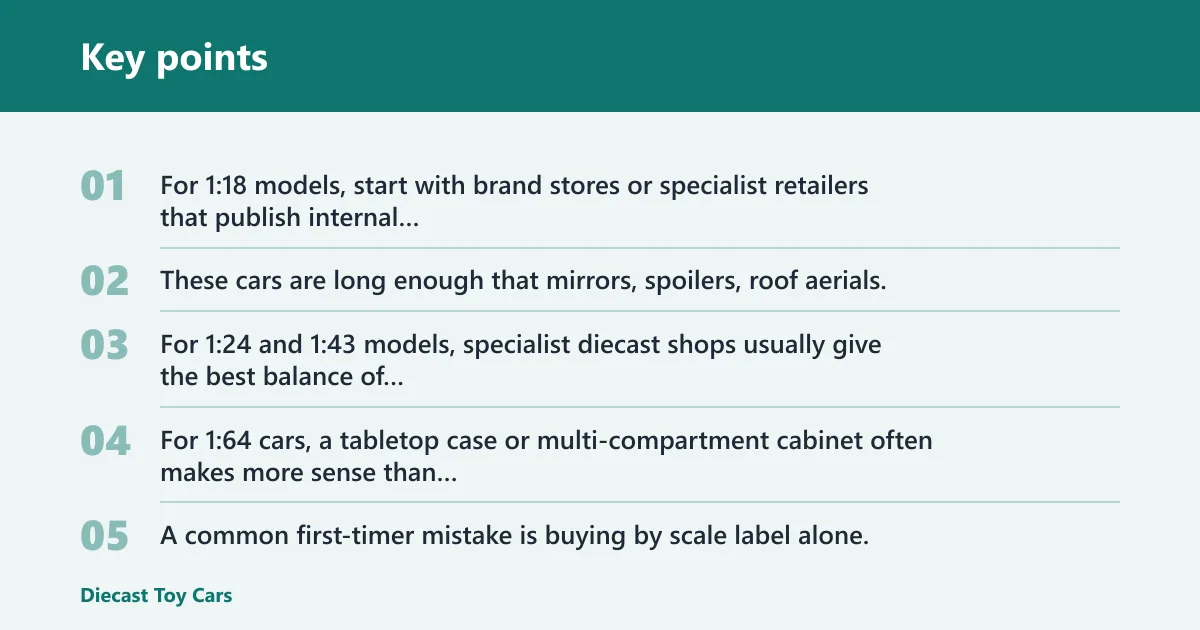
For 1:18 models, start with brand stores or specialist retailers that publish internal measurements and mounting details. These cars are long enough that mirrors, spoilers, roof aerials, and side skirts can turn a “looks close” case into a scrape risk.
For 1:24 and 1:43 models, specialist diecast shops usually give the best balance of selection and fit information. For 1:64 cars, a tabletop case or multi-compartment cabinet often makes more sense than a large single-model display, especially if you collect in batches.
A common first-timer mistake is buying by scale label alone. A 1:43 label does not guarantee a snug fit if the internal length is short or the base height steals clearance from tall mirrors or a roof antenna.
When to choose a tabletop case or wall display
Choose a tabletop case when you want easy access, display flexibility, and lower mounting risk. Choose a wall display when floor or shelf space is limited and the display is meant to stay fixed in place. Wall formats are common for 1:43, 1:24, and 1:18 collections, but only if the mounting surface can carry the load.
Elfershop’s wall display is listed for 8 to 50 models and measures 62.5 x 50 x 17.3 cm. That kind of format suits a curated group display, not every oversized or unusually tall car.
When a replacement case makes more sense than a new display
If the original model case is scratched, cracked, or missing, a replacement case is usually the simpler buy. That is especially true for branded models where the base, card, or label matters as much as the cover. A replacement keeps the presentation consistent without forcing you to rebuild the whole display setup.
Use a new complete display case only when the old one is structurally damaged or when you need a different format, such as moving from a single-cover case to a multi-car cabinet.
Display case buyer matrix
This table compares the four main buying channels by fit certainty, return risk, scale coverage, protection features, and assembly burden. Use it as a fast filter before you compare individual listings.
| Buying channel | Fit certainty | Return risk | Scale coverage | Dust protection | UV protection | Wall-mount options | Typical assembly requirements |
|---|---|---|---|---|---|---|---|
| Brand store | High for the stated model family | Low to medium, depending on shipping damage policy | Usually narrow, often one model line or one scale | Often included on enclosed cases | Only if explicitly listed | Sometimes, but not the default | Usually low; often assembled or simple panel fitting |
| Specialist diecast shop | Medium to high when dimensions are published | Medium, because fit depends on measured clearance | Broad; often 1:43, 1:24, 1:18, and accessory formats | Common on enclosed and cabinet-style cases | Only on selected listings | Common for display and cabinet formats | Medium; flat-pack cases and wall units may need setup |
| Marketplace | Variable; depends on seller photos and measurements | High if packaging or description is weak | Very broad, including rare and used cases | Variable; inspect latches, seams, and lids | Rare unless the listing states it | Uncommon, but available in some listings | Variable; may be flat-pack, used, or incomplete |
| Replacement-parts seller | High when the case is listed for your exact model family | Low to medium, depending on packaging and fit verification | Focused; common for replacement covers and 1/43 cases | Good when the replacement is a full enclosure | Only if the product listing states it | Usually no | Low to medium; often simple cover swap or base fit |
How do you check scale fit?
Measure the car, not only the box label. Scale names like 1:18, 1:24, 1:43, and 1:64 help, but the real fit comes from the model’s longest point, highest point, and widest point compared with the case’s internal dimensions. External size alone is not enough.

Measure the car, not only the box label
Start with the model’s overall length, width, and height, then compare those numbers to the case’s internal clearance. The case may look large from the outside and still be too shallow once the base, lid, or frame thickness is accounted for.
- Measure the car from bumper to bumper, including spoilers and mirrors.
- Measure the tallest point, including antennas or roof fins.
- Compare both figures to the case’s internal dimensions, not the outside shell.
- Leave a small buffer for safe handling and for the base insert, if present.
Leave clearance for mirrors, spoilers, and antennas
Allow extra room where the model sticks out from the main body. A low-slung race car may fit in length but fail in height once you add a rear wing. A pickup or off-road model may need more width than a standard coupe.
Say your 1:43 NASCAR diecast fits the case length on paper but the roof antenna touches the lid. That is a fit problem, not a scale problem, and the fix is a case with more internal height or a taller base design.
Match internal dimensions to the model’s longest point
Use the longest point as the primary check. If the model is 1:18, a case like Agora’s 690 x 375 x 310 mm internal space gives a concrete reference for what “fit” means in a published listing. The same logic applies to smaller scales: internal clearance decides whether the car sits safely or presses against the cover.
Acrylic or glass display case?
Acrylic and glass are not interchangeable. Acrylic is lighter and gives clear visibility, which makes it common for covers, lids, and replacement cases. Glass is heavier and suits sealed cabinets better, especially when the door and seal system are designed together.
Acrylic for clear visibility and lower weight
Acrylic is a common choice for collectors who want a light case with good visibility. It is used in covers, lids, and replacement cases because it is easier to handle than glass. The tradeoff is scratch resistance: acrylic can mark more easily if it is cleaned with the wrong cloth or rubs against loose parts.
Elfershop’s premium BBR display case uses 3mm scratch-resistant acrylic material. That kind of spec is worth checking because acrylic quality and thickness vary by seller.
Glass for sealed cabinets and heavier builds
Glass suits heavier cabinet builds and sealed styles, especially when dust control matters. It also pairs well with door seals and closure hardware, but it adds weight and demands stronger support. For wall units, that extra mass matters during mounting and long-term load planning.
Dust seal strip fit for glass-door cases
For a glass-door cabinet, check seal compatibility before buying accessories. Elfershop’s dust seal strip is designed for 6mm thick glass doors, and its dustproof strip length is 1709 mm. It also lists an 8mm soft closure band, so the door thickness and closing style need to match the strip design.
Wall display and rotating stand options
Wall displays and rotating stands solve different problems. A wall display is for fixed, multi-level presentation. A rotating stand is for a single model that needs a full-view display. If you combine them, check weight, depth, and how much clearance the model needs while rotating.
Wall display load and clearance checks
Heavy 1:18 models need extra caution in wall-mounted formats. Check the mounting hardware, the wall surface, and the total loaded weight before purchase. Also check depth, because a long model can project forward enough to hit nearby shelves or a wall edge.
Elfershop’s wall display is listed for 1/43, 1/24, and 1/18 scales, but that does not mean every 1:18 car is safe in every slot. Tall spoilers, wide mirrors, and heavy die-cast bodies should be checked against the stated dimensions before mounting.
Rotating display stand specs to verify
Elfershop sells a rotating display stand with 2 rotation speeds, a 25.5 cm diameter, and battery or AC power options. It is listed as suitable for 1/43, 1/32, 1/24, and 1/18 models. That makes it a useful add-on for tabletop presentation, not a replacement for a fitted display case.
Check the platform diameter against the model’s wheelbase and overhang. A stand can support the model and still be a poor match if the car extends too close to the edge during rotation.
When a stand pairs well with a case
A rotating stand pairs well with a case when the case protects a single model and the stand is used for presentation outside the case. It is less useful for tightly packed cabinets or for carded models, where the packaging itself is the display.
Frequently asked questions
Where can you buy display cases for diecast cars?
You can buy them from brand stores, specialist diecast retailers, marketplace sellers, and replacement-parts suppliers. Brand stores are best for exact-fit cases. Specialist shops cover more scales and formats. Marketplaces help with rare or discontinued items. Replacement sellers help when only the cover or base needs replacing.
Are display cases available by scale like 1:18 or 1:43?
Yes, many are sold by scale, including 1:18, 1:24, 1:43, and 1:64. The scale label helps, but it is only a starting point. Internal dimensions, base thickness, and model details such as mirrors or spoilers decide whether the car fits cleanly.
Can you buy a dustproof display case for diecast cars?
Yes, many enclosed cases are built to reduce dust entry, and some cabinet systems add seal strips or closing bands. Check whether the listing names a dust seal, closed door, or gasket-style fit. If the seller does not mention it, do not assume full dust protection.
Do display cases come in acrylic or glass?
Yes. Acrylic cases are lighter, clear, and common for covers, lids, and replacement cases. Glass cases are heavier and better suited to sealed cabinets with proper door hardware and seals. They are not interchangeable, so the material should match the display format and mounting plan.
Where can you find a wall display case for heavy 1:18 models?
Look to specialist diecast retailers and carefully check the load rating, mounting method, and depth. A wall display may be listed for 1:18 models, but the car’s actual size and weight still matter. Heavy models need extra clearance and secure fixings, not only a scale label.
Can you buy replacement display cases for model cars?
Yes. Replacement-parts sellers and some specialist shops sell acrylic or plexiglas replacement cases, including 1/43 examples and multi-compartment cabinets. These are useful when the original case is cracked, missing, or badly scratched. Match the replacement to the model family and internal dimensions before ordering.
Are rotating display stands sold with display cases?
Sometimes, but not usually as a standard bundle. Rotating stands are often sold separately from display cases because they solve presentation rather than protection. If you want both, check the stand diameter, power option, and model scale, then confirm that the case still closes or lifts off cleanly.