What Is the Best Place to Sell Diecast Cars Online?
For most diecast cars, eBay is the best online selling place; use local cash sale or collector groups for bulk lots, and consignment only for high-value pieces when you want less effort. Choose the wrong channel and fees, shipping, and slow listings can shrink your net payout fast. This guide compares payout, speed, effort, and risk by inventory type so you can choose the right venue.
Choosing by collection type and payout
The best place depends on what you are selling, how fast you want cash, and how much work you want to do. Common loose cars often suit eBay or a lot sale. Rare boxed pieces often do better with collector auction traffic or consignment. Mixed estate collections often fit a dealer buyout or local cash sale.
Fast answer by inventory type
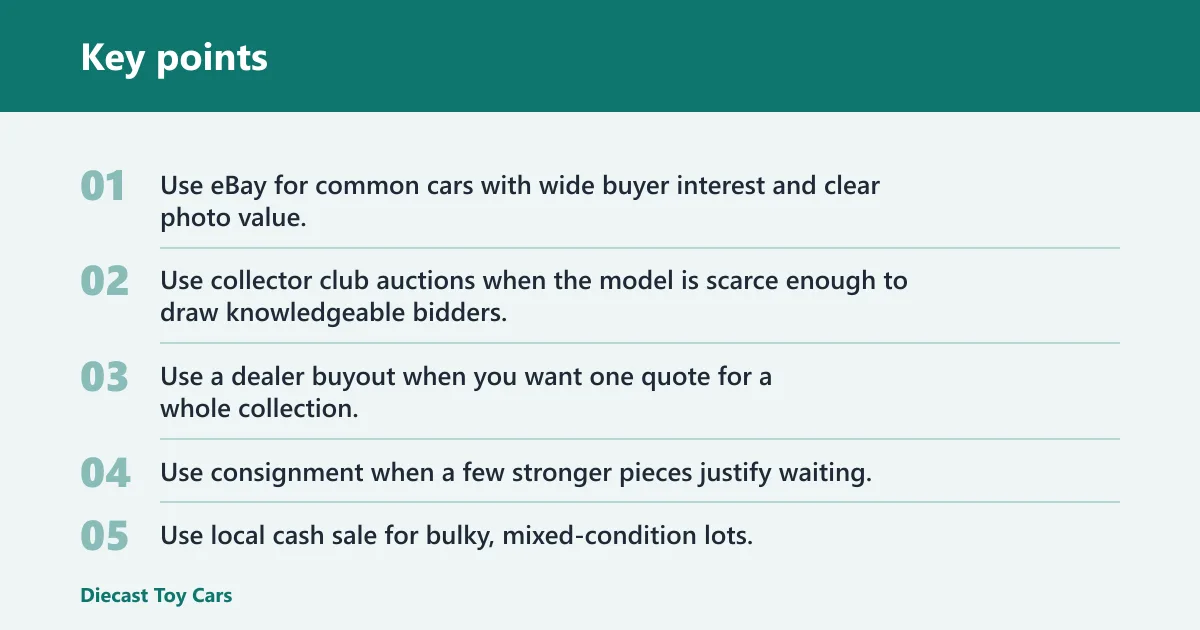
Use eBay for common cars with wide buyer interest and clear photo value. Use collector club auctions when the model is scarce enough to draw knowledgeable bidders. Use a dealer buyout when you want one quote for a whole collection. Use consignment when a few stronger pieces justify waiting. Use local cash sale for bulky, mixed-condition lots.
Best channel by net return
Net payout is what matters after fees, packing time, shipping, and the delay before money lands. A higher headline price can still leave you with less cash than a lower offer if the channel takes a large commission or requires many hours of listing and post-sale handling. That is why a buyer quote is sometimes better than a public listing.
When to avoid a channel
Avoid one-by-one listings when the cars are low value, dusty, or incomplete. Avoid a dealer buyout if you have a few rare castings that deserve collector attention. Avoid local cash sale if the collection is small and easy to ship, because the buyer pool may be too narrow. Avoid any channel that leaves you unable to verify payment or handoff.
Diecast sale matrix
This table compares five common selling channels by net payout, speed, effort, scam risk, and fit. The score is relative, so you can compare the tradeoffs quickly. A higher net payout score does not mean a higher listing price; it means stronger cash left after the usual selling friction.
| Channel | Net payout | Speed | Effort | Scam risk | Best-fit inventory type |
|---|---|---|---|---|---|
| eBay | 4/5 | 4/5 | 2/5 | 3/5 | Common cars, quick-turn stock, one-by-one listings |
| Collector club auction | 4/5 | 3/5 | 3/5 | 4/5 | Rare models, collector-grade boxed pieces, auction pricing |
| Direct dealer buyout | 3/5 | 5/5 | 5/5 | 5/5 | Whole collections, inherited lots, mixed-condition inventory |
| Consignment | 4/5 | 2/5 | 4/5 | 4/5 | Higher-value pieces, select boxed models, patient sellers |
| Local cash sale | 3/5 | 5/5 | 5/5 | 2/5 | Bulky lots, mixed condition, immediate pickup sales |
- Common loose cars: eBay or local lot sale if you want the fastest cleanout.
- Rare boxed pieces: collector club auction or consignment for stronger collector demand.
- Mixed estate collection: dealer buyout if you want a single offer and less handling.
- High-value single model: consignment or auction if the model draws specialist bidders.
- Inherited mixed collection: sort the standout pieces first, then sell the rest as a lot.
Should you sell on eBay or to a collector site?
eBay gives the broadest consumer-to-consumer reach, which helps common and quick-turn inventory, but fees and shipping work can cut into the final amount. Collector sites reach fewer people, yet the audience is more targeted, and specialist buyers may pay more for a specific casting, variant, or box condition.
eBay reach and fee pressure
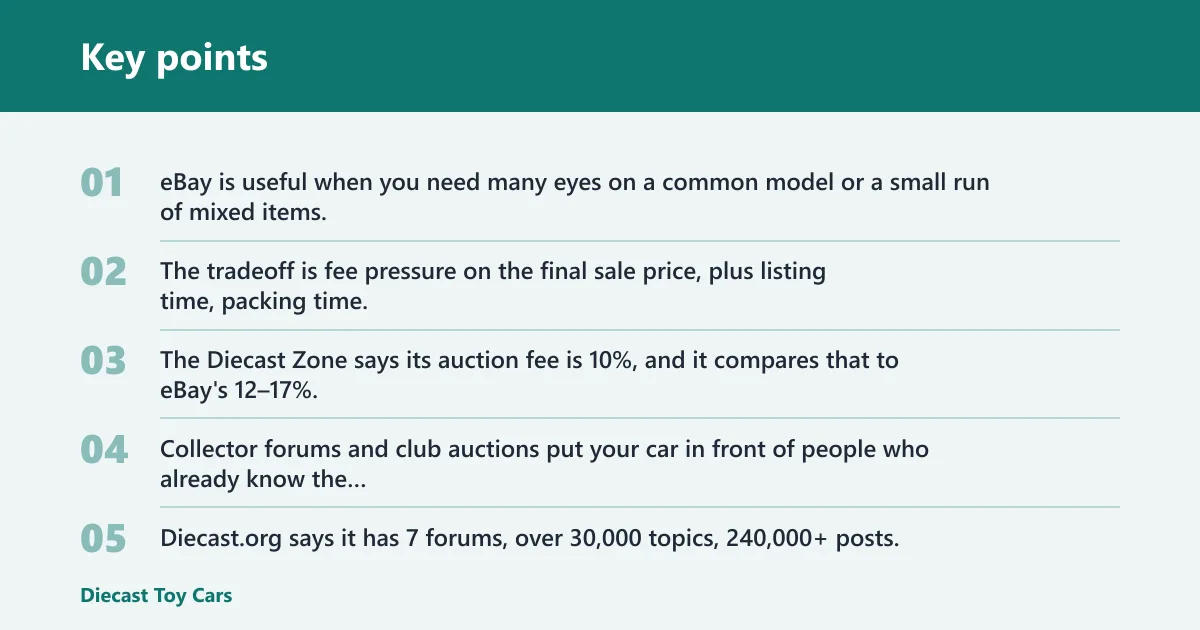
eBay is useful when you need many eyes on a common model or a small run of mixed items. The tradeoff is fee pressure on the final sale price, plus listing time, packing time, and the risk of returns or payment disputes. The Diecast Zone says its auction fee is 10%, and it compares that to eBay’s 12–17%.
Collector club auctions and specialist buyers
Collector forums and club auctions put your car in front of people who already know the model and often care about variations, packaging, and condition. Diecast.org says it has 7 forums, over 30,000 topics, 240,000+ posts, and a club with 2,000+ members. That focused audience can help rare models find the right bidder.
The Diecast Zone says sellers can sell rare models in its auctions, and it invites collection owners to email [email protected] for help. That is a useful path when a castings list is small but strong, especially if the buyer is likely to recognize a scarce issue or a complete boxed set.
When auction pricing can beat a fixed-price listing
Auction pricing can beat a fixed listing when the model is scarce, well documented, and easy for collectors to compare. If two or three serious buyers want the same piece, an auction can pull the price higher than a fixed listing that sits unnoticed. That advantage is strongest for rare variants and collector-grade packaging.
Suppose you have a boxed, scarce model with clean corners and original inserts. A fixed-price listing may attract a single buyer, but an auction can bring out collectors who compete on that exact issue. The same model in loose, dusty condition may do better as a lower-effort lot instead.
When does a direct dealer buyout make sense?
A direct dealer buyout makes sense when speed, simplicity, and certainty matter more than chasing top dollar. It is especially practical for bulk collection quotes, inherited lots, and mixed-condition groups where one-by-one listing would take too long. A dealer can quote the whole lot, then arrange pickup or shipping.
Bulk collection quotes
DHS Diecast says it is actively purchasing quality diecast collections, and it names construction, classic cars, trucks, military, aviation, and agriculture as core categories. It also describes its process as quote to pickup or shipping. That format works well when you want one offer instead of sorting dozens or hundreds of pieces.
Condition and brand selectivity
Dealer buyouts are selective. Stronger brands, cleaner boxes, and better-known series usually matter more than plain bulk. A mint boxed car will usually be easier to place than a loose example with dust, shelf wear, or missing parts. Lower-grade pieces may still move, but they are less likely to earn a premium in a buyout quote.
Pickup, shipping, and convenience
Pickup or shipping options reduce friction, especially for large collections. The value here is convenience: one conversation, one quote, one transfer. The cost is that the dealer needs room for margin, so the offer may be lower than a specialist sale. That is the normal trade for speed and low effort.
Is consignment better for higher-value diecast?
Consignment is often the better path for higher-value diecast when you can wait for the right buyer and want less handling than a full self-sale. It usually gives you more price control than a buyout, but it also shifts the sale timeline longer. It works best for pieces that can justify attention.
Commission rate versus time to sale
Consignment uses a commission rate instead of an immediate buyout discount. That can be a fair trade when the car is rare or boxed well enough to attract collectors. It is less attractive for ordinary loose cars, because the extra time may not add much net cash after commission.
Pricing control
Consignment gives more control than a dealer offer because you can often set a reserve, a target price, or at least a minimum acceptable range. That matters for premium castings where condition and maker reputation can move the value a lot. It also helps if the model has a niche audience that may bid up under auction conditions.
Who handles the inventory
With consignment, the seller or the platform may handle the inventory, photos, listing text, buyer communication, and packing. That changes the workload significantly. If the platform handles more of the process, you save time. If you handle more of it, your work rises, but the listing can be more precise and better documented.
What changes the value of a diecast car?
Condition, packaging, rarity, maker reputation, and scale all influence value. Mint boxed cars usually command more than loose cars. Dust, shelf wear, and missing parts usually push value down. Scarcity matters because uncommon variants can attract specialist buyers who know exactly what they are looking at.
Mint boxed versus loose
Mint boxed pieces usually fit collector channels better because the packaging supports the condition story. Loose cars can still sell well, but they are often better suited to eBay, lots, or local sales unless the model itself is scarce. A clean loose car is stronger than a damaged boxed one, but original packaging usually helps.
Original packaging and shelf wear
Original packaging matters because it confirms completeness and helps with display value. Shelf wear, crushed corners, sticker residue, and faded cards can all lower appeal. For many buyers, a box with light wear is still acceptable, but heavy damage will narrow the buyer pool and may make a dealer quote more conservative.
Scarcity, scale, and maker reputation
Scarcity can matter more than age. A well-known maker and a desirable scale can lift buyer interest even when the item is not perfect. Common issues, by contrast, need clean presentation and competitive pricing. This is why one model can be worth listing individually while another belongs in a lot sale.
Missing parts and mixed-condition lots
Missing mirrors, tampos, wheels, or packaging usually lower value fast. Mixed-condition lots are better sold as a group when the weak pieces would take too much time to list individually. A common first-timer mistake is treating an estate lot as if every car deserves the same effort. The stronger pieces deserve more attention; the rest may be better bundled.
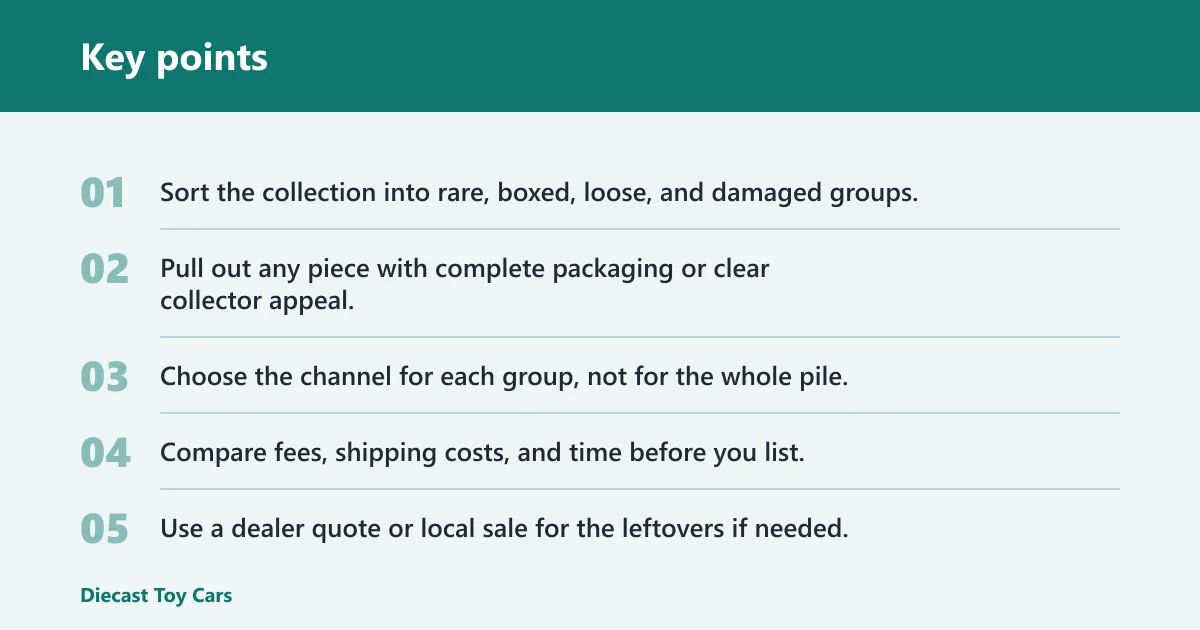
- Sort the collection into rare, boxed, loose, and damaged groups.
- Pull out any piece with complete packaging or clear collector appeal.
- Choose the channel for each group, not for the whole pile.
- Compare fees, shipping costs, and time before you list.
- Use a dealer quote or local sale for the leftovers if needed.
Picture a mixed lot of around 40 cars with dust, card wear, and a few missing mirrors. The lot may sell better as a bulk local cash sale or a dealer buyout than as 40 separate listings, because the low-value items would absorb too much time. A single mint boxed chase piece from the same lot deserves a different path.
Frequently asked questions
Where can I sell my diecast cars?
You can sell diecast cars on eBay, collector forums, club auctions, consignment platforms, dealer buyouts, or local cash sale channels. For the best net return, match the channel to the inventory. Common loose cars usually fit eBay or lots. Rare boxed models often fit collector buyers or consignment. Whole collections can go to a dealer.
What is the best place to sell diecast cars online?
For most cars, eBay is the strongest all-around online option because it has broad reach and fast buyer traffic. For rare models, collector sites and club auctions can be better because the audience is more targeted. For whole collections, a direct buyout may be better if you value speed and fewer steps.
Where can I sell diecast cars for the most money?
The highest net money usually comes from the path that fits the item best, not from one universal site. Rare boxed pieces may earn more through collector auctions or consignment. Common loose cars may earn more net cash on eBay if they sell quickly. Whole lots can earn more in a buyout when time matters.
Should I sell diecast cars on eBay or to a collector site?
Choose eBay for broad exposure, quick-turn models, and common inventory. Choose a collector site when the car is rare, boxed, or likely to interest a specialist who knows the variation. If the item is ordinary, eBay usually has the better balance of speed and access. If it is scarce, collector buyers may pay more.
What fees should I expect when selling diecast online?
Expect marketplace fees, payment fees, packing material costs, shipping, and your own time. The Diecast Zone says its auction fee is 10%, and it compares that to eBay’s 12–17%. A lower fee can still lose to a worse buyer pool if the item sits too long or needs extra handling.
Can I sell a whole diecast collection instead of listing each car?
Yes. Whole collection sales are common, especially for inherited or mixed-condition lots. A dealer buyout or local cash sale is often the fastest route. If the collection includes a few valuable boxed pieces, it can pay to split those out first and sell the rest as a lot or in one quote request.