What Condition Grading Scale Should Diecast Collectors Use?
Proposed standard, grounded in common collector practice: This grading framework follows the condition language commonly used by collector communities, auction-house descriptions, and brand-specific cataloguing norms for diecast models. The 0-10 weights and cutoffs below are an original, proposed standard designed to make loose, boxed, and factory-defect grading repeatable and comparable across listings. It separates model condition from packaging condition, because that is how serious buyers usually read diecast descriptions.
Use a 10-point, three-factor scale: grade the model, box, and factory defects separately, then assign one final label based on those scores. Weak grading skews prices and makes listings harder to trust because buyers cannot compare one model against another. This guide gives a repeatable scale for loose and boxed diecast cars, with clear rules for wear, packaging, and production flaws.
Compact checklist: check paint and finish first; then chips and scratches; then moving parts; then decals and tampos; then completeness. Record factory defects separately from later wear. Grade the model and the box independently. If the model is loose, say so plainly instead of forcing a packaging grade.
How the seven-grade scale works
Use seven bands: Mint, Near Mint, Excellent, Very Good, Good, Fair, and Poor. Mint is generally tighter than Near Mint, with no visible wear under normal inspection. A single label helps only when you apply the same checks every time.
Condition basics
Condition grading should be a consistency tool, not a value estimate. It says nothing about what a model is worth. The aim is simple: two collectors should read the same description and reach the same grade from the same evidence.
The cleanest way to keep that standard is to grade the model on its own, then grade the box on its own. Packaging can matter, but it should not blur the condition of the car, truck, bus, or racing model inside it.
Collector norms support that separation. Auction houses typically describe wear, damage, and completeness in plain condition language, while dedicated brand guides for makers such as Hot Wheels, Matchbox, Corgi, Dinky, and Majorette usually distinguish casting condition from card, blister, or box condition. This framework follows that same separation and makes it explicit.
Mint versus Near Mint
Mint is the strictest label. It should mean no visible wear on the model under normal inspection, no chips, no scratches, no obvious dulling, and no damage that would catch the eye at arm’s length. Near Mint can allow the faintest trace of handling, but not defects that read as wear at once.
That difference matters because collectors use Mint as a near-factory-fresh claim. If a model has visible rubbing on a roof edge or a small paint chip on a mirror, it should move out of Mint even if the rest of the casting is clean.
Why a single label can be too vague
A lone grade can hide important differences. Two models can both be called Excellent while one has flawless paint and a battered box, and the other has a clean box but a chip on the hood. Separate checks keep those differences visible.
That is also why this page separates factory defects from later wear. A production flaw belongs in the condition notes, but it should not be treated the same as damage after purchase.
Five factors that should drive the grade
Use five factors: paint and finish, chips and scratches, moving parts, decals and tampos, and completeness. Those five checks cover the main visible and working signs collectors use most often, and you can score them the same way for loose and boxed pieces.
Paint and finish
This check covers gloss level, color consistency, and any dulling or yellowing. A clean paint job should look even from panel to panel. Haze, chalking, or a faded roof line lowers the grade, even if no chips are present.
Chips and scratches
Look for visible paint loss, including spots that go down to bare metal or primer. Small marks may still fit a mid-grade model, but a chip that shows primer is a clearer defect than a faint rub that only appears in strong light.
Moving parts, decals, and completeness
Moving parts include doors, hoods, hatches, wheels, and couplers. They should open, close, roll, or engage as intended without missing pieces or binding. Decals and tampos should stay crisp, with no lifting, cracking, or broad fading. Completeness covers original stands, certificates, spare parts, keys, and included accessories.
Say your 1:43 rally car has perfect body paint but one door hinge feels loose and the door no longer sits flush. That issue should not sit inside a general “good condition” label; it belongs in the moving-parts score and in the final note.
Grade thresholds by condition band
Use observable thresholds, not mood. Mint should show no visible wear. Near Mint allows only trivial handling signs under careful inspection. Excellent can have light, isolated flaws. Very Good can show clear but limited wear. Good, Fair, and Poor reflect broader damage or loss.
Mint through Excellent
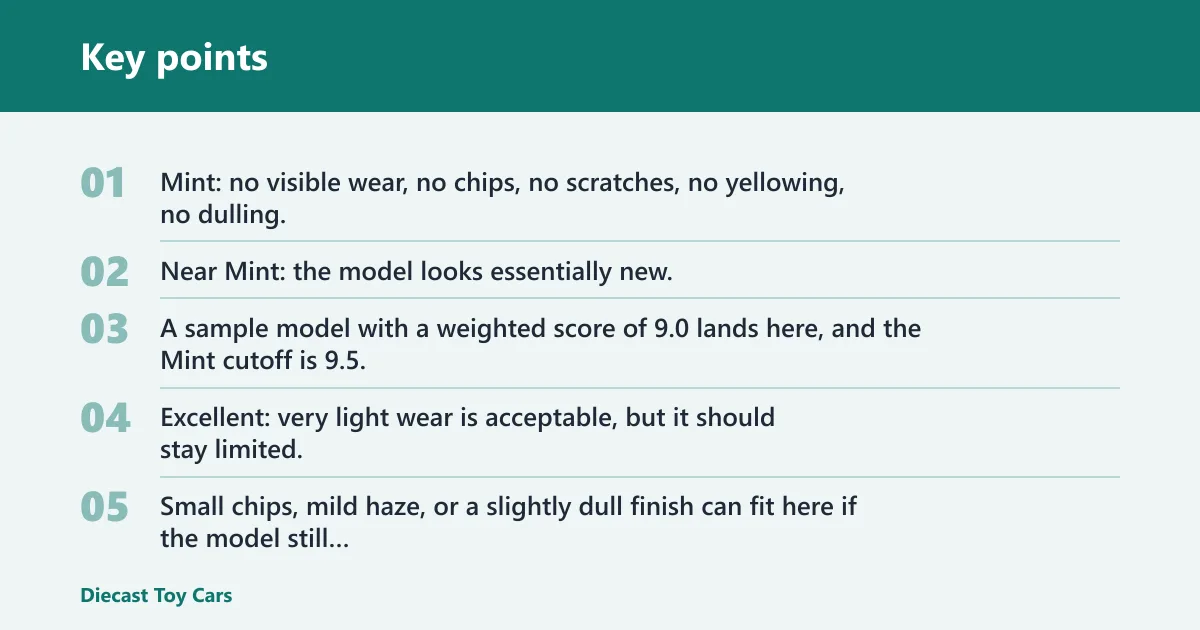
Mint: no visible wear, no chips, no scratches, no yellowing, no dulling, no function loss, and no missing factory parts. The model should look nearly untouched.
Near Mint: the model looks essentially new, but careful inspection may reveal a tiny handling mark, a faint rub, or a barely visible flaw that does not change the overall look. A sample model with a weighted score of 9.0 lands here, and the Mint cutoff is 9.5.
Excellent: very light wear is acceptable, but it should stay limited. Small chips, mild haze, or a slightly dull finish can fit here if the model still presents cleanly at arm’s length.
Very Good through Poor
Very Good: visible wear is allowed, but it should stay moderate and controlled. The example score of 5.65 lands in Very Good, and the framework says Very Good clears a 5.5 cutoff. A car with a few chips, light rubbing, or small decal loss can fit this band if the rest remains sound.
Good: wear is obvious. Chips may be larger or more numerous, the finish may look tired, or one moving part may not work correctly. The model is still presentable, but the defects are easy to spot.
Fair: heavy wear, missing accessories, broken parts, or broad finish problems. This grade is for models with clear loss of appearance or function.
Poor: severe damage, major part loss, or a model that is far from complete and no longer presents as a collectible condition piece.
Why paint and chips weigh more than function: collectors usually see finish problems first, and surface condition tends to affect perceived quality more quickly than a minor mechanical issue. A model can still display well with a stiff hinge or slightly off-center wheel, but a chipped hood edge, roof rub, or patchy finish changes the first impression immediately. That is why paint and chips carry the highest combined weight.
Diecast grading matrix
This matrix gives each factor a pass/fail style threshold for every band. It also separates the box grade, because the box should usually be reported independently from the model. If there is no box, record “no box” rather than forcing the model into a lower condition grade.
| Factor | Mint | Near Mint | Excellent | Very Good | Good | Fair | Poor | Box grade |
|---|---|---|---|---|---|---|---|---|
| Paint and finish | Full gloss, even color, no dulling or yellowing | Near-perfect gloss, no obvious wear | Light haze or slight dulling only | Noticeable dulling or mild yellowing | Clear finish loss or uneven color | Heavy fading, haze, or stained finish | Severe surface loss or major discoloration | Grade separately from model |
| Chips and scratches | No chips, no visible scratches | No meaningful wear under close look | One or two tiny marks | Small chips visible at arm’s length | Multiple chips or deeper scratches | Large chips, bare metal, or primer exposure | Extensive loss, dents, or broad damage | Box wear does not change model chips |
| Moving parts | All parts function cleanly, no looseness | All parts function, minimal play | Light looseness or minor stiffness | One minor hinge, wheel, or coupler issue | Clear function problem, but partly usable | Broken or missing moving part | Multiple failures or nonfunctional parts | Box does not fix function defects |
| Decals and tampos | Sharp, complete, no fading or lifting | Sharp with no meaningful loss | Very slight edge wear or faint fading | Minor fading or tiny lift visible | Clear fading, thin spots, or small cracks | Lifted, cracked, or heavily worn markings | Major loss of printed detail | Box graphics are scored separately |
| Completeness | All original stands, certificates, keys, and accessories present | Complete with no loss | One minor accessory absent if not essential | One small original item missing | Several missing extras | Missing key original items | Very incomplete or parts-only | Box presence reported as separate field |
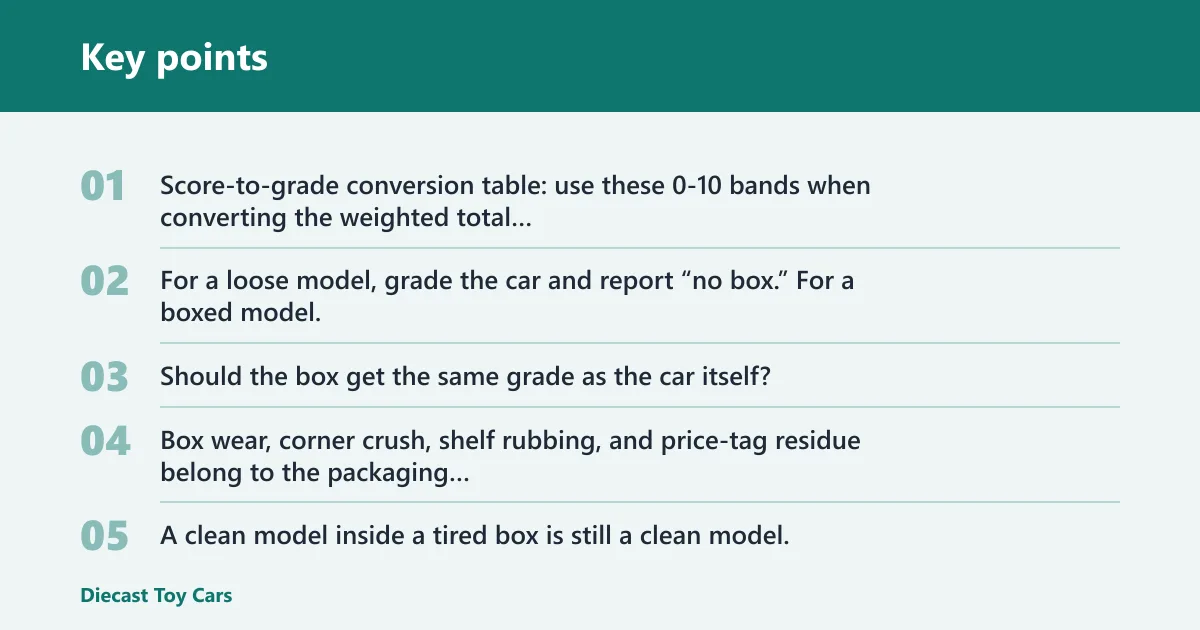
Score-to-grade conversion table: use these 0-10 bands when converting the weighted total to a label.
| Score band | Grade | Typical read |
|---|---|---|
| 9.5-10.0 | Mint | Essentially untouched, no visible wear |
| 9.0-9.4 | Near Mint | Virtually new, with only trace handling signs |
| 8.0-8.9 | Excellent | Very light wear, still displays cleanly |
| 5.5-7.9 | Very Good | Visible but moderate wear |
| 3.0-5.4 | Good | Obvious wear, still presentable |
| 1.0-2.9 | Fair | Heavy wear, missing items, or major defects |
| 0.0-0.9 | Poor | Severe damage or very incomplete |
Loose-versus-boxed decision rule
For a loose model, grade the car and report “no box.” For a boxed model, record the model grade and the box grade separately, then write them together as “model + box.” For a carded release, the card is part of the packaging grade, but it should not replace the model grade.
Should the box get the same grade as the car itself? No. Box wear, corner crush, shelf rubbing, and price-tag residue belong to the packaging grade. A clean model inside a tired box is still a clean model.
How do you score borderline cases?
Borderline cases should be decided by what is visible, how widespread it is, and whether it reads as wear or as original production variation. Light rubbing, minor wheel damage, and age-related yellowing can move a model down one band, but they do not all count the same way.
Light rubbing and haze
Light rubbing on a roof edge, mirror, or bumper can still fit Excellent if it takes effort to see and does not break the overall look. Once the mark is visible at arm’s length, it belongs in Very Good or lower. Haze is similar: faint haze may fit Excellent, but broad clouding pushes the grade down.
Suppose a 1:64 sedan has a slight dull strip across the hood and one tiny nick on the trunk. If those flaws are visible only in direct light, the model can still stay in Excellent. If the finish looks flat from across the table, it should not.
Minor wheel or hinge damage
A wheel that sits slightly off-center, a hinge that is loose, or a coupler that no longer locks cleanly should be counted under moving parts. If the model still functions, the grade may remain in Very Good. If the defect stops the feature from working, the score should drop further.
Yellowing, lifting, and cracking
Age-related yellowing belongs in paint and finish, not in chips and scratches. Lifted decals and cracked tampos belong in the decal score. Factory defects matter here too: if the yellowing came from the original plastic mix or clear coat, note it as a production flaw rather than later damage, then grade it once and consistently.
That distinction matters for edge cases collectors recognize quickly. A yellowed transparent part on an otherwise clean model may be original production aging rather than misuse. Likewise, a paint speck left from the factory should be identified as a manufacturing defect, while a missing piece after opening should be treated as later loss.
How do you turn checks into one grade?
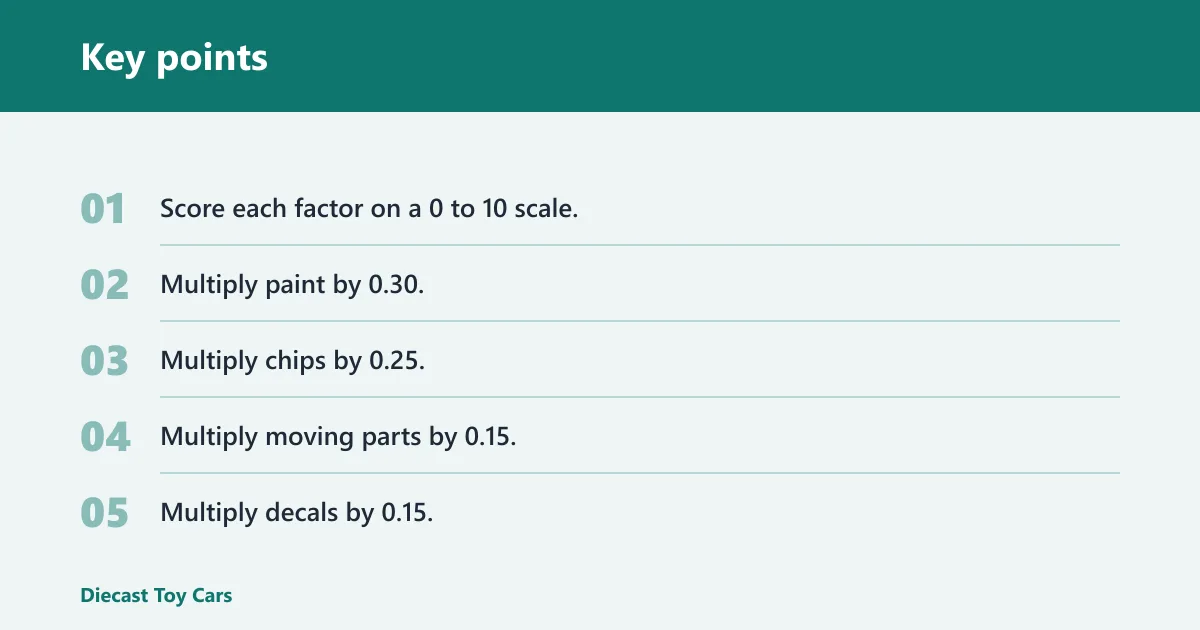
Use weighted scoring: paint at 30%, chips at 25%, moving parts at 15%, decals at 15%, and completeness at 15%. Score each factor on a 0-10 scale, convert the total to a 10-point result, then match that result to the nearest label. This keeps the final grade honest without hiding weak areas.
Weighted scoring method
- Score each factor on a 0 to 10 scale.
- Multiply paint by 0.30.
- Multiply chips by 0.25.
- Multiply moving parts by 0.15.
- Multiply decals by 0.15.
- Multiply completeness by 0.15.
- Add the five weighted results.
- Match the total to the grade bands.
That method is simple enough to repeat, and it keeps one small defect from overruling everything else. A single scratch should matter, but it should not erase a flawless casting, especially when the other four checks remain strong.
When to round up or down
Round down when the defect is easy to see at arm’s length, affects function, or sits in a high-visibility area such as the hood, windshield, or roof. Round up only when the flaw is tiny, isolated, and does not change the overall presentation.
A common first-timer mistake is to give the same final grade to two models because both have one flaw. One has a tiny paint fleck under the chassis line; the other has a chipped door edge and a loose hood. Those are not equal defects, so they should not receive the same label.
Worked example 1: loose model. A loose 1:64 sedan scores 9.0 on paint, 8.5 on chips, 9.5 on moving parts, 9.0 on decals, and 8.5 on completeness. Weighted total: 2.70 + 2.13 + 1.43 + 1.35 + 1.28 = 8.89. That lands in Excellent.
Worked example 2: boxed model. A boxed rally car scores 9.6 on the model, but the box scores 7.2 because of edge wear and one crushed corner. Report it as Near Mint model, Good box. The packaging is clearly weaker, but it does not downgrade the car itself.
Worked example 3: factory-defect case. A new-in-box casting has a factory paint speck and a slightly misaligned tampo, but no later wear. Score the defect as a production issue, not as handling damage. If the model still presents like new and the defect is minor, it can remain Near Mint rather than dropping into a wear-based grade. The note should say “factory paint flaw” so buyers know it was original.
How to report model plus box
Write the final condition as two labels: model grade plus box grade. Example format: “Near Mint model, Excellent box.” If there is no box, say “Loose, Near Mint model” or “No box, Excellent model.” That wording keeps the packaging separate and avoids confusion in listings.
If you want the listing to be even clearer, add a short condition note after the label: for example, “small hood chip,” “light shelf wear on card,” or “factory tampo misprint.” That level of detail is consistent with auction-house style condition descriptions and helps buyers compare one piece to another.
Frequently asked questions
What condition grading scale should diecast collectors use?
Use a seven-band scale: Mint, Near Mint, Excellent, Very Good, Good, Fair, and Poor. That gives you enough room to separate near-factory-fresh pieces from lightly worn ones, while still leaving space for visible damage, missing parts, and heavily worn models.
Is Mint the same as Near Mint for diecast cars?
No. Mint should be stricter and should allow no visible wear under normal inspection. Near Mint can allow the faintest handling trace, but it should still look essentially new. If the flaw is easy to spot, the model is past Mint.
How should I grade a loose diecast car versus a boxed one?
Grade the car itself first, then note whether it is loose or boxed. A loose car gets one model grade and a note that there is no box. A boxed car gets two grades: one for the model and one for the packaging.
Should the box get the same grade as the car itself?
No. The box should be graded separately because shelf wear, corner crush, and fading affect packaging, not the model’s condition. A damaged box can lower the overall listing appeal, but it should not drag down an otherwise clean car.
What factors should count most when grading diecast condition?
Paint and finish should carry the most weight at 30%, followed by chips and scratches at 25%. Moving parts, decals and tampos, and completeness each count for 15%. That split puts the most weight on what collectors see first and what usually changes condition fastest.
How do I turn separate condition checks into one overall grade?
Score each factor, apply the weights, and total the result on a 10-point scale. Then map that score to the nearest grade band. Use the model score and box score separately, so a worn box does not distort the car’s actual condition grade.
How should sellers describe borderline or factory-defect examples?
State the visible issue plainly and distinguish production flaws from later damage. Use wording such as “factory paint speck,” “original tampo misalignment,” or “minor shelf wear.” That approach aligns with collector and resale listing standards because it tells buyers exactly what is original, what is worn, and what is missing.
Related guides: diecast storage, diecast display, cleaning diecast models, packaging preservation, and resale listing standards.