Do Loose Diecast Cars Have Value Without Packaging?
Yes. Loose diecast cars can still sell for meaningful money, but the value depends on the casting, condition, and how scarce the piece is. For common modern cars, a loose example may bring only a small fraction of carded value; for premium variants, Super Treasure Hunts, and vintage castings, the missing package can hurt less than many sellers expect. This guide shows when packaging matters most, how to price loose cars, and when to hold instead of sell.
Do loose diecast cars have value?
Yes. A loose diecast car can have real resale value, but the key question is whether it has some value or meaningful resale value. Packaging widens the buyer pool and helps with verification, so a loose car usually sells to fewer collectors than a carded one.
Some value versus meaningful resale value
A loose diecast car with wear and a common casting may only bring a low-dollar sale, while a scarce variant or vintage casting can still command strong interest. Collector price guides and sold-comps marketplaces show the same pattern: rarity and condition drive the result more than the fact that a car is loose. Use Hot Wheels values as the reference point, then discount for missing packaging.
- Common mainline: Usually low resale, especially if the paint is worn.
- Premium or rare casting: Can still hold strong value if originality is clear.
- Vintage piece: Scarcity can outweigh the box penalty.
When the missing box hurts most
The box hurts most when the car is common, modern, and easy to replace. In those cases, the card often carries the larger share of the premium because sealed buyers disappear and the car becomes harder to verify. Hot Wheels’ own collector references also make packaging part of the product story, especially for limited or chase pieces.
- Common modern mainlines lose the most value when loose.
- Premium variants lose trust value without the card.
- Rare castings lose less if the piece is clearly original.
How packaging affects resale value
Original packaging helps because it widens the buyer pool, supports authenticity, and lowers shipping risk. A sealed car can appeal to carded collectors and display buyers; a loose car usually appeals mainly to loose collectors. That difference often changes the final sale price more than sellers expect.
Carded versus loose buyer pools
A sealed car has two demand paths: collectors who keep pieces carded and collectors who want a display-ready item. A loose car usually has only one path: the loose collector. Sold-listing evidence on marketplaces like eBay and collector price guides repeatedly shows that a narrower buyer pool can slow a sale even when the casting is desirable.
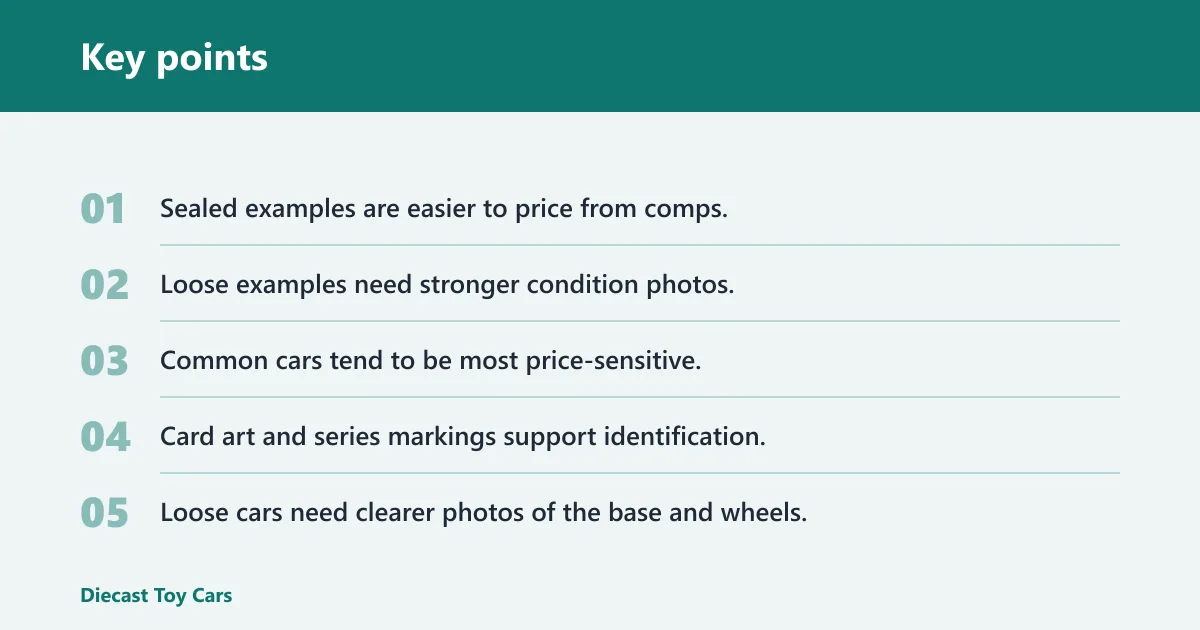
- Sealed examples are easier to price from comps.
- Loose examples need stronger condition photos.
- Common cars tend to be most price-sensitive.
Authenticity, storage, and shipping risk
Original packaging helps with authenticity because the card art, series marking, and blister context support the identity of the piece. Without that, buyers rely on the car itself, which is harder for premium variants and limited-run pieces. Packaging also helps protect the car in storage and transit, reducing new damage risk.
- Card art and series markings support identification.
- Loose cars need clearer photos of the base and wheels.
- Packaging reduces shipping wear and buyer hesitation.
Why box condition still matters
When a car is carded, the box is part of the product. Dents, tears, sun fading, moisture damage, and crushed blisters lower value because buyers read them as storage problems and possible hidden wear. A clean carded example can outprice a cleaner loose car simply because the presentation is stronger.
- Look for dents, creases, tears, and fading.
- Check blister clarity and seal strength.
- Factor card condition into every offer.
Value decision table
This table separates small packaging penalties from cases where missing packaging sharply cuts resale value. It also shows when loose is acceptable and when sealed condition still carries the real premium.
| Type | Loose value expectation | How much packaging matters | Best buyer type | Sell-or-hold recommendation |
|---|---|---|---|---|
| Common mainline | Low; often near the bottom of the market and sometimes around the loose-car floor | High. The card usually carries most of the resale premium | Price-focused loose collectors | Sell fast if the casting is ordinary and condition is average |
| Premium mainline or variant | Moderate to strong if the car is clean and originality is clear | Medium to high. Packaging still matters, but the car itself carries more weight | Variant collectors and buyers searching for a specific casting | Sell if condition is strong; hold only if the variant is scarce |
| Super Treasure Hunt | Strong if the Spectraflame paint and Real Riders are intact; can still attract serious buyers | Very high. Missing packaging makes verification harder and can hurt trust | Advanced collectors who know the castings | Hold until you can verify details and price against verified sales |
| Vintage or rare casting | Can remain high even when loose, especially if rarity is the main driver | Medium. Scarcity offsets the box penalty, but provenance still matters | Vintage collectors and rarity buyers | Hold if the piece is scarce, original, and not heavily worn |
For many common loose pieces, current sold comps may support only a minimal floor. Treat any rough floor like a conditional example tied to casting, condition, and buyer pool rather than a universal number. A clean, rare casting can be far above that level; a worn common car may be near it.
What condition details matter most?
Condition is one of the most important factors in diecast pricing. For loose cars, buyers look first at paint chips, scratches, missing parts, wheel condition, fading, sun damage, and originality. A car can be loose and still grade well, but visible damage cuts confidence fast.
Paint chips, scratches, and fading
Paint is the first thing buyers see. Chips on the roof, hood, or sides lower the grade because they are easy to spot in photos and hard to ignore in hand. Scratches and roofline rubbing add more damage points, and sun fading is especially harmful on bright colors.
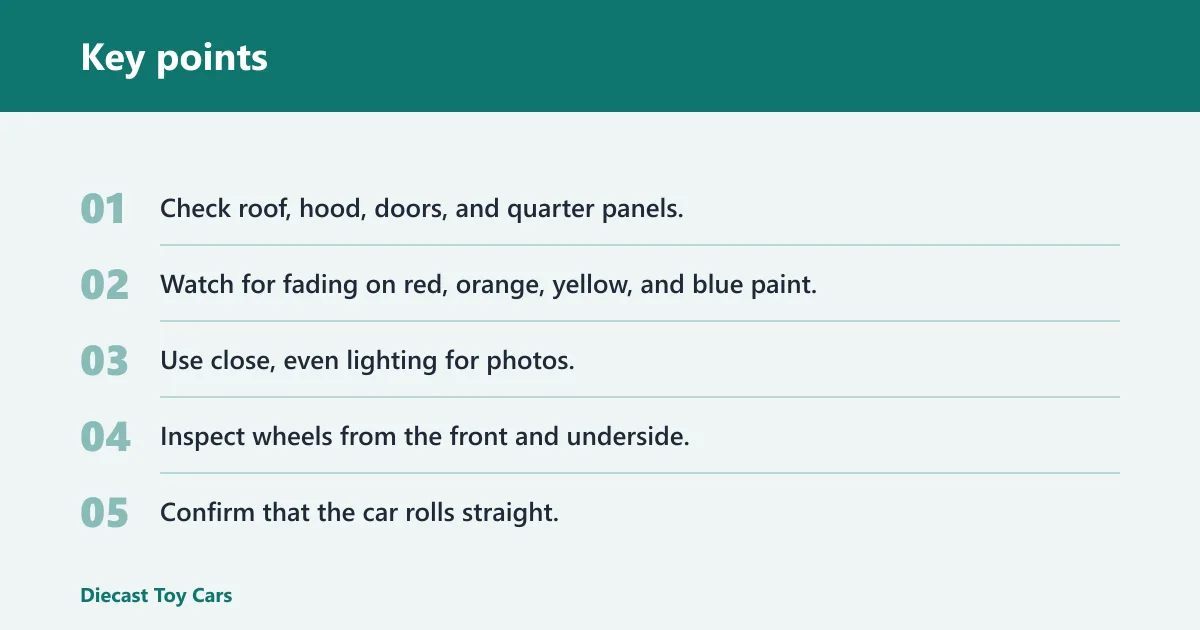
- Check roof, hood, doors, and quarter panels.
- Watch for fading on red, orange, yellow, and blue paint.
- Use close, even lighting for photos.
Missing parts and wheel condition
Missing mirrors, spoilers, tampos, or a loose axle reduce value. Wheel condition matters because buyers want straight, clean-rolling wheels and the correct style where applicable. Bent axles or mismatched wheels can push a car out of the stronger resale tier.
- Inspect wheels from the front and underside.
- Confirm that the car rolls straight.
- Note any missing trim or accessories.
Originality and replacement parts
Originality is a major pricing filter. A loose car with replacement wheels, altered paint, or swapped parts is usually worth less than an untouched example. Buyers of rare castings care about hidden modifications because the packaging is gone and the proof is weaker.
- Compare the base and wheel style to known originals.
- Be careful with repaint or restoration claims.
- Assume originality matters more as rarity increases.
Using a six-step grade scale
- Mint: Near-new appearance, no obvious wear, and no missing parts.
- Near Mint: Tiny wear only, with strong paint and clean wheels.
- Excellent: Light chips or scratches, but still attractive to buyers.
- Good: Visible wear, but complete and presentable.
- Fair: Heavy wear, faded paint, or obvious damage.
- Poor: Missing parts, severe damage, or major originality issues.
Those grades should guide pricing. Mint and Near Mint are where loose premium cars keep most of their appeal. Fair and Poor are usually price-driven sales only.
- Grade the car before you list it.
- Use the grade to set your asking range.
- Do not overstate condition on worn pieces.
Can a loose Super Treasure Hunt still sell well?
Yes, if the car is authentic and clean. Official Hot Wheels identifiers for Super Treasure Hunts include Spectraflame-style paint, Real Riders rubber tires, and the special treasure-hunt treatment on the card when present. Without the card, the proof burden rises, but a clean loose example can still attract serious buyers.
Spectraflame paint and Real Riders
Hot Wheels Super Treasure Hunts are limited chase pieces, and the key traits collectors check first are Spectraflame paint and Real Riders. Those details matter because they are part of the official identification process, and they help distinguish the super from the standard mainline release.
- Confirm the metallic-style paint finish.
- Check for Real Riders rubber tires.
- Compare the casting to known super variants.
Gold-flame TH logo checks
On the carded version, the gold-flame “TH” logo is one of the clearest identifiers. That is why a loose Super Treasure Hunt is harder to sell confidently: buyers lose one of the fastest authentication cues and may ask for sharper base, wheel, and finish photos before paying full value.
- Use the card logo when it is available.
- Without the card, photograph the base and wheels.
- Expect tighter buyer scrutiny on premium pieces.
Why verification is harder without the card
Missing packaging lowers confidence, especially for premium Hot Wheels. The card ties the car to a specific release, and sold-comps listings often rely on that evidence. Without it, buyers may discount the offer until they are satisfied the casting, wheels, and paint are correct.
- Provide clear close-ups of the base.
- Show the wheel style from both sides.
- Price conservatively until authenticity is clear.
How should you price loose cars?
Price loose cars by condition grade, rarity tier, packaging penalty, and buyer pool. Common cars should be priced quickly and realistically. Premium and rare castings can be held longer if the condition is strong and the packaging loss is the main issue. The goal is to match the car to the buyer who will actually pay for it.
Match price to buyer segment
If the car is common, aim at loose collectors and price accordingly. If it is a premium mainline or variant, compare it to similar sold examples rather than carded listings. If it is a Super Treasure Hunt or rare casting, verify the details before setting a firm price. Internal guides like Super Treasure Hunt identification and diecast condition grading can help keep the estimate consistent.
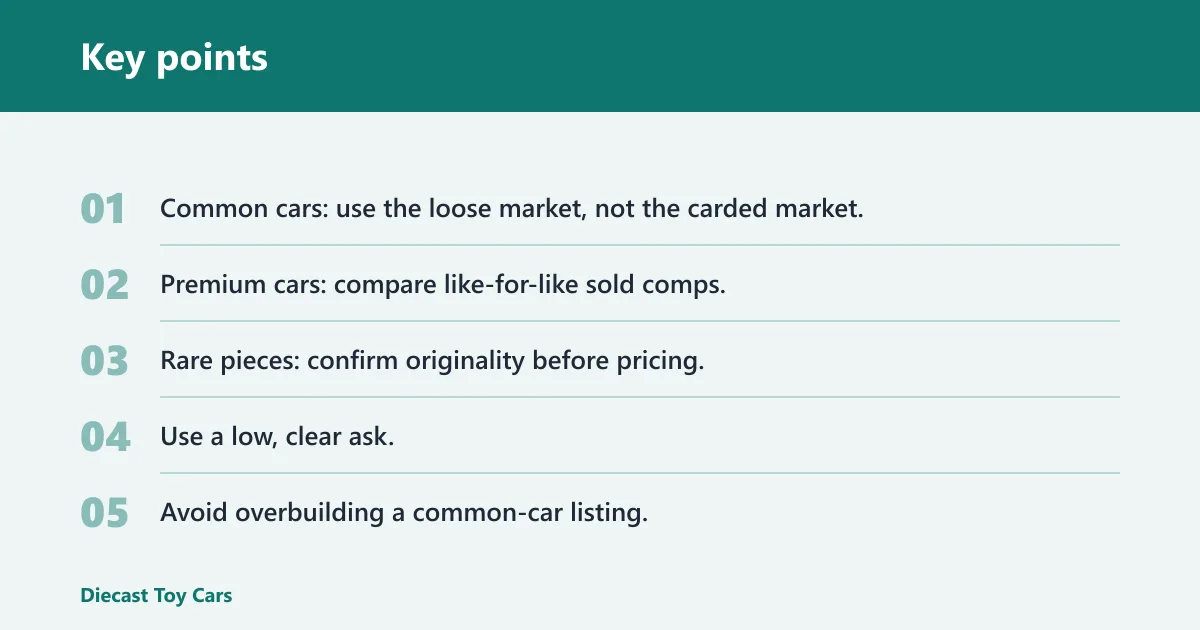
- Common cars: use the loose market, not the carded market.
- Premium cars: compare like-for-like sold comps.
- Rare pieces: confirm originality before pricing.
Price common cars fast
Common mainlines usually do not justify a long hold. Loose common cars are usually worth far less than boxed ones, and common loose examples rarely appreciate unless they are unusual variants or error pieces. If the paint is worn and the wheels are basic, move the listing quickly and keep the price simple.
- Use a low, clear ask.
- Avoid overbuilding a common-car listing.
- Bundle if the single-car value is weak.
Hold rare castings longer
Rare castings are different because scarcity can offset the packaging penalty. If the car is original, hard to find, and in strong condition, the missing box may matter less than the rarity itself. That is where patience can help, especially if sold comps are thin and the buyer pool is specialized.
- Hold only when scarcity is real, not assumed.
- Verify originality before waiting for a higher offer.
- Use patience on rare pieces, not on worn commons.
Practical pricing steps
- Identify the casting and release type first.
- Check whether it is common, premium, limited, or vintage.
- Inspect paint, wheels, parts, and originality.
- Compare loose examples with carded examples of the same type.
- Adjust downward if the packaging is missing and buyers will need extra verification.
- Price fast if the car is common; hold only when rarity or condition supports it.
Simple loose-pricing formula: start with a sold-comp baseline, then adjust for condition grade, rarity tier, packaging penalty, and buyer pool. For example: better condition raises the result, common-tier cars lower it, missing packaging subtracts more on modern releases than vintage ones, and a narrow buyer pool pushes the number down again. Use selling diecast cars as the final check before listing.
- Condition grade: Mint/Near Mint adds value; Fair/Poor subtracts it.
- Rarity tier: Common, premium, chase, or vintage changes the ceiling.
- Packaging penalty: Strongest on modern common cars.
- Buyer pool: Wider pools support faster sales and firmer prices.
Worked example: common mainline. A loose common Hot Wheels with average paint, no special variant, and normal wheels should be priced off the low end of sold comps, with a packaging discount applied. If the car is merely presentable, the correct move is usually to price it to sell, not to wait for a carded-style number.
Worked example: Super Treasure Hunt. A loose Super Treasure Hunt with verified Spectraflame paint, Real Riders, and clean condition can still justify a premium price, but the missing card usually means a buyer will discount it until authenticity feels secure. The closer the car is to Near Mint, the smaller that discount tends to be.
Worked example: vintage casting. A vintage loose casting with original parts and strong originality can outperform a modern loose piece even without packaging. Here, scarcity and collectability matter more than the box, so condition and provenance are the main pricing levers.
Frequently asked questions
Are loose diecast cars worth anything without the original packaging?
Yes. Many are, but value depends on the casting, condition, and buyer pool. Loose cars usually sell for less than carded examples, and common mainlines may sit near the low end. Rare, premium, or vintage pieces can still bring strong prices if originality and condition are solid.
- Common cars: low resale, especially if worn.
- Rare or premium cars: can still bring meaningful money.
- Vintage pieces: scarcity can outweigh the missing box.
How much value do loose diecast cars lose compared with carded ones?
The drop varies by type. For common modern cars, the loss can be substantial because the card is a large part of the collectible premium. For rare or premium pieces, the gap may be smaller. Sold-comps data and collector guides are the best way to judge the discount on a specific casting.
- Common modern cars lose the most.
- Scarce pieces lose less when rarity is strong.
- Always compare sold examples, not asking prices.
Which loose diecast cars can still sell for good money?
Premium mainline cars, limited variants, Super Treasure Hunts, and vintage or rare castings can still sell well if condition is strong. Clean Spectraflame paint and Real Riders are especially important on Super Treasure Hunts. Scarcity and originality matter more as the car moves up-market.
- Premium variants can do well if the details are correct.
- Super Treasure Hunts need strong authentication cues.
- Vintage castings can stay valuable even when loose.
Does a missing box hurt Hot Wheels value a lot?
Yes, especially on common modern cars and premium variants. The box helps verify the release, broadens the buyer pool, and protects the resale premium. On a loose common mainline, the box often carries more value than the car itself. On a rare casting, the penalty can be smaller.
- Biggest hit: common modern releases.
- Moderate hit: premium variants.
- Smaller hit: rare or vintage castings.
Can a loose Super Treasure Hunt still be valuable?
Yes. A loose Super Treasure Hunt with clean Spectraflame paint and Real Riders can still attract serious buyers. The challenge is verification. Without the card and its gold-flame “TH” logo, buyers rely more on the car’s details and may discount the price until authenticity feels secure.
- Check paint finish and tire type first.
- Use close photos of the base and wheels.
- Expect more scrutiny than on carded examples.
What condition issues matter most on loose diecast cars?
Paint chips, scratches, missing parts, wheel condition, fading, sun damage, and originality matter most. Condition is one of the most critical factors in determining diecast value, and a clean, original car will almost always beat a worn one, even if both are loose.
- Paint wear is usually the fastest value killer.
- Wheel and axle problems reduce buyer confidence.
- Original parts help preserve the strongest tier.