How Rare Is My Hot Wheels Car If It Is Loose and Unboxed?
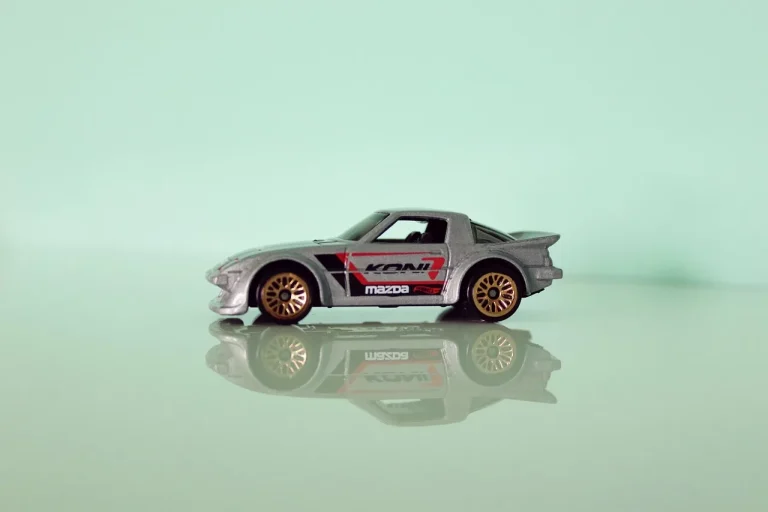
A loose, unboxed Hot Wheels car is usually less rare than the same car on-card, unless it is a documented short-run, error, chase, or limited variation. If you miss that, you can overpay for common castings or underprice a genuinely scarce variation. This guide shows how to identify the casting, separate factory rarity from condition damage, and judge how uncommon it really is.
Loose rarity triage table
Use this table as a fast filter. It does not assign a final price by itself. It helps you sort what looks scarce from what only looks different because the packaging is gone.
| Clue | What it suggests | How reliable it is | What to verify next | Confidence | Red-flag note |
|---|---|---|---|---|---|
| Base casting name | Identifies the model family | Medium | Match the exact casting name with release details | Moderate | Same casting name can cover multiple releases |
| Copyright year on base | Tooling or design date, not release year | Low to medium | Compare with series, graphics, and wheel setup | Low | The base alone is not enough to date a loose Hot Wheels car |
| Country stamp | Can help narrow manufacture period or plant | Medium | Check whether the country matches the expected release range | Moderate | Country alone does not prove rarity |
| Wheel type | Mainline, premium, or swapped wheels | High | Compare against verified examples from the same release | High | Wheel swaps can fake premium status |
| Real Riders rubber wheels | Premium-style release or later swap | High | Verify the release used rubber wheels originally | High | Do not assume rubber wheels mean factory original |
| Plastic mainline wheels | Typical mass-market issue | High | Check whether the release was a mainline or premium variant | High | Common wheel style can still appear on scarce castings |
| Paint finish | Standard, metallic, Spectraflame, or repaint | Medium | Compare finish with release photos and catalog records | Moderate | A seller’s claim of a rare color needs supporting identification and sales evidence |
| Tampo style | Graphics can mark a specific release | High | Match tampo layout, logos, and text placement | High | Repainted cars can keep old graphics or get fake ones |
| Axle condition | Loose, bent, repaired, or replaced hardware | Medium | Inspect wheel alignment and roll behavior without forcing it | Moderate | Damage can reduce value without changing rarity |
| Paint loss and roof rub | Condition wear from play or storage | High | Document exact wear spots, not just “good” or “bad” | High | Wear affects price more than scarcity |
| Missing parts | Headlights, spoilers, surfboards, or interiors may be absent | High | Compare against a complete reference example | High | Incomplete cars are harder to compare fairly |
| Drilled posts or screw marks | Restoration, repair, or custom work | High | Check underside, posts, and paint edges for tampering | High | Factory originals should not be mixed with customs |
| Fresh paint edge lines | Possible repaint or touch-up | Medium | Look for overspray, masked seams, and mismatch at base edges | Moderate | Touch-up can hide repairs and alter value |
| Chase indicators | T-Hunt or STH traits, if release-specific | Medium | Confirm the exact release, paint, wheels, and date code | Moderate | Loose verification is harder because the card is gone |
What the base tells you
The base is your starting point, not your finish line. The casting name molded into the base, the country stamp, and the copyright year help identify the toy, but they do not by themselves prove which release you have. Two cars with the same casting name can be different releases.
Castings and release differences
Check the exact model name first, then match it against the series or set. Color, graphics, and wheel combination can define a separate variation even when the casting name stays the same. Loose Hot Wheels value depends on the exact release, condition, and comparable sold cars.
A common first-timer mistake is to stop at the base name and call the car “the 2005 version” because the underside shows 2005. That year may only be the copyright date. The release can be much later, or it can be one of several variants that share the same tooling.
Copyright year versus release year
Copyright year is described more as a tool date than as a release date. The base alone is not enough to date a loose Hot Wheels car. You need the casting name, graphics, wheels, and series context before you can place it with confidence.
Country of manufacture clues
Country stamps can narrow the field, especially on older pieces, but they are support evidence. They do not override release-specific details. Treat them as one clue among several, not as proof of rarity or premium status.
How rare is your loose car?
Start by separating rarity from condition. A scratched, chipped, or dusty car can still be scarce. A clean common casting is still common. Judge the release, not only the model, and flag uncertain examples early instead of forcing a neat answer.
- Identify the exact casting name on the base.
- Match the series or set, not just the model name.
- Check whether the wheel style fits that release.
- Describe condition in specific terms.
- State originality plainly: factory original, repainted, wheel-swapped, repaired, or uncertain.
- Compare only with sold loose examples that match the same release.
Separate rarity from condition
Condition and originality must be judged together, because a car can be rare and worn, or common and clean. Paint chips, scratches, roof rub, axle damage, and missing parts lower desirability, but they do not by themselves change the factory run. Children’s Toy Closet notes that scarcity drives demand and demand holds value only when the car survives intact.
That difference matters most with loose cars. Missing packaging changes the buyer pool, but it does not alter production numbers. A car can be hard to find and still show heavy wear. It can also be easy to find and still look excellent.
Flag uncertain examples early
If the car has a repaint, wheel swap, drilling, or restoration, say so plainly. Collector research should reject mismatched comparables and customs. If originality is uncertain, keep the car out of direct comparisons with verified factory originals until the question is settled.
Why wheels and paint matter
Wheel type, paint finish, and graphics often separate one collectible version from another more than the casting name does. Wheel variation can create distinct collectible versions. The same model with plastic mainline wheels and with Real Riders rubber wheels is not the same comparison set.
Mainline wheels versus Real Riders
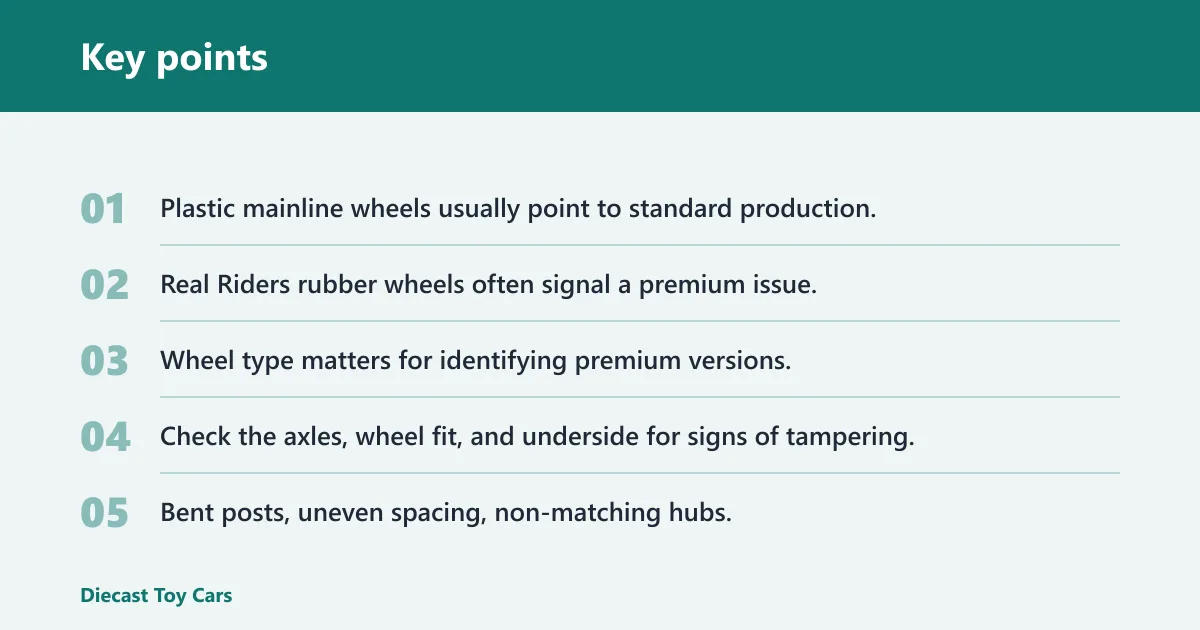
Plastic mainline wheels usually point to standard production. Real Riders rubber wheels often signal a premium issue, but they can also be swapped onto another car. Wheel type matters for identifying premium versions, yet it is also one of the easiest details to fake.
Wheel swaps and fake premium cues
Check the axles, wheel fit, and underside for signs of tampering. Bent posts, uneven spacing, non-matching hubs, or obvious glue can point to a swap or repair. Do not treat a rubber-wheeled loose car as premium until the release supports that setup.
Paint finish and tampo style
Spectraflame, metallic paint, standard gloss, and matte finishes can each point to different product lines or years. Tampo placement matters too. A clean tampo can still be wrong if the text, logo size, or placement does not match known examples. A seller’s claim of a rare color needs supporting identification and sales evidence.
Say a red loose Camaro has rubber wheels and a shiny finish. That still does not prove it is a Super Treasure Hunt. You need the exact release, the correct graphics, and a sales trail from the same version before you call it scarce in that way.
Can a loose Hot Wheels still be rare without packaging?
A loose Hot Wheels car can still be rare if the release is scarce, the variation is documented, or the car is a verified error or chase. Packaging loss usually changes value more than factory rarity. The key is to separate the missing card from the production facts.
Factory rarity without packaging
Loose and carded evidence should be kept separate. A loose example can be uncommon because the production run was short, the variation was limited, or the car is a numbered release. Numbered releases are a clear scarcity signal, but the number still needs to be tied to the exact release, not assumed from the base alone.
When packaging loss changes value more than rarity
Loose cars are usually reported to have a smaller buyer pool than carded cars. That does not mean the toy became less rare. It means fewer collectors want it in that format, and some collectors pay less for a car without its blister or card. The packaging can matter for value and authenticity, but there is no fixed percentage deduction that works for every loose car.
Treasure hunt and super treasure hunt claims
Chase status needs release-specific proof. Loose verification is harder because the card is gone, and the card often carries the clearest clue. Premium features can include Spectraflame paint and Real Riders wheels, but those features alone do not prove chase status. You still need the correct release-level match.
How to check sold prices
Use completed sales first. A completed, verified transaction is stronger evidence than an active asking price. Use sold listings rather than active listings. Old sales can help with context, but they may be stale. Evidence should include date and source type for each comparable.
Match loose examples only
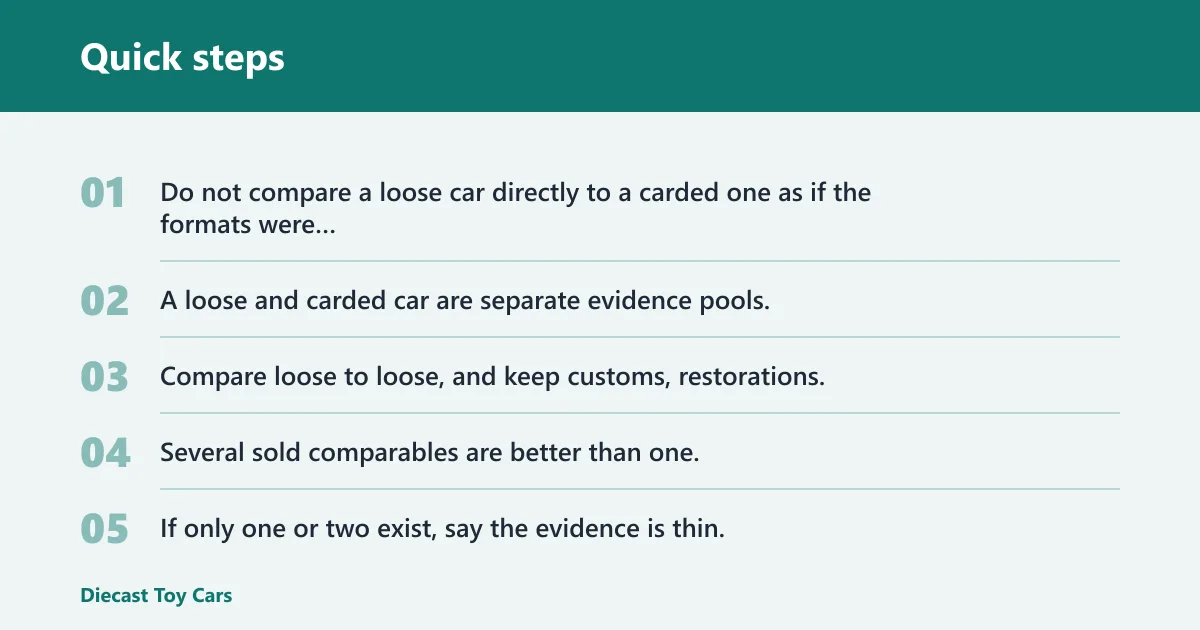
Do not compare a loose car directly to a carded one as if the formats were interchangeable. A loose and carded car are separate evidence pools. Compare loose to loose, and keep customs, restorations, and wheel swaps out of the set unless the car you are studying is also modified.
Look for multiple comparables
Several sold comparables are better than one. If only one or two exist, say the evidence is thin. Hot Wheels value research should use a range and explain confidence. That is the honest answer when the market sample is small.
Say your loose car is a late-1990s mainline with heavy edge wear and a bent front axle. If the only comparable you can find is a pristine carded listing from a different color and wheel setup, that sale does not answer your question. It is the wrong comparison, even if the model name matches.
How to read a weak market signal
If sold prices are scattered, first check whether the examples truly match. Two cars with the same casting name can be different releases. If the color, graphics, or wheels differ, the market may be pricing different objects, not one object at different condition levels.
Frequently asked questions
How rare is my Hot Wheels car if it is loose and unboxed?
Its rarity depends on the exact release, not on the fact that it is loose. Start with the casting name, then the series, wheel type, paint, and originality. A loose car may be less desirable than the carded version, but packaging loss does not erase factory rarity.
Can a loose Hot Wheels car still be rare without packaging?
Yes. A documented short run, numbered release, chase, or rare variation can still be uncommon when loose. The missing card changes comparability and often lowers buyer interest, but it does not automatically make the toy common. Verification still needs release-specific proof.
What details should I check on a loose Hot Wheels car to judge rarity?
Check the exact casting name, copyright year, country stamp, series, color, graphics, wheel type, and any signs of repair or repainting. Then compare those details to sold examples of the same release. The more specific the match, the more useful the rarity read becomes.
Does being loose automatically lower a Hot Wheels car’s value?
No. Loose cars usually have a smaller buyer pool, so value often drops versus carded examples, but the amount varies widely. There is no universal percentage deduction. Condition, originality, and release rarity all matter more than packaging alone.
How do I tell if a loose hot wheels is a treasure hunt or super treasure hunt?
You need release-level proof, not just a shiny finish or rubber wheels. Confirm the exact casting, graphics, paint, wheels, and the matching chase version from that year or series. Loose cars are harder to verify because the card clue is gone, so caution matters.
When is a loose Hot Wheels car too uncertain to value accurately?
When the car may be repainted, wheel-swapped, repaired, or missing original parts, or when you have only one weak comparable. If the release cannot be matched cleanly, say the value is uncertain rather than guessing. A range with low confidence is better than a false precision.