How to Display Carded Hot Wheels on a Wall Safely
Use a wall system that keeps the card flat, spreads the load across studs or a full cabinet frame, and stays out of direct sun and damp rooms; that is the safest setup for most carded Hot Wheels. Poor mounting bends the card, stresses the blister, and can leave permanent adhesive damage. This guide shows the safest wall options, how to pick hardware by risk level, and the least damaging installation method.
What you’ll need
- Pegboard panel with a 1-inch grid spacing
- 2½-inch wood screws for stud mounting
- Wall stud finder and level
- Spacers or furring strips for pegboard clearance
- Pegboard hooks spaced 4-6 inches apart
- Floating shelf, 3-4 inches deep
- 12V LED strip lighting, 4000K-5000K
- Mounting hardware matched to your wall type
- IKEA Detolf cabinet or similar cabinet-style case
- 2-inch acrylic risers for stepped rows in a cabinet
- UV-filtering acrylic for premium custom cases
- UV-filtering film for nearby glass
- Silica gel packets for enclosed displays
- Top loaders, 3×4 inches, for standard cards
- Semi-rigid card savers for premium cards
Carded hot wheels table
| Display method | Mounting hardware | Max practical use case | Risk level | Best-fit card type |
|---|---|---|---|---|
| Pegboard display system | Mounted to wall studs with 2½-inch wood screws; use spacers or furring strips behind the board | Scalable carded car wall display where you want flexible hook placement | Moderate, when installed correctly | Standard cards and carded cars in protectors; works well for repeatable series layouts |
| Floating shelf display | Wall-fastened shelf bracket system sized for the wall type | Single-row display in a clean room or hallway | Lower than open hooks if the wall is sound | Sealed Hot Wheels in protectors; best for short runs and premium cars |
| IKEA Detolf glass cabinet | Cabinet frame on its included base; shelves measure 16⅝” × 14⅝” | Protected cabinet-style display with stepped rows or acrylic risers | Lowest exposure to dust and touch | Premium cards, short cards, long cards, and higher-value sealed cars |
| Custom enclosed case with UV-filtering acrylic | Case-specific wall mount or cabinet support; use UV-filtering acrylic | High-value display where fading control matters most | Lowest light exposure when fully enclosed | Premium cards, mint-condition blister packs, and valuable variations |
Which wall display is safest for your cards?
For the lowest risk, choose a cabinet-style display. For a wall that needs a lighter look, a shelf is the next safest choice if the card sits flat and the wall can support the load. Pegboard is best when you need flexibility, but only if it is mounted to studs and spaced off the wall properly.
Choose by card value and room conditions
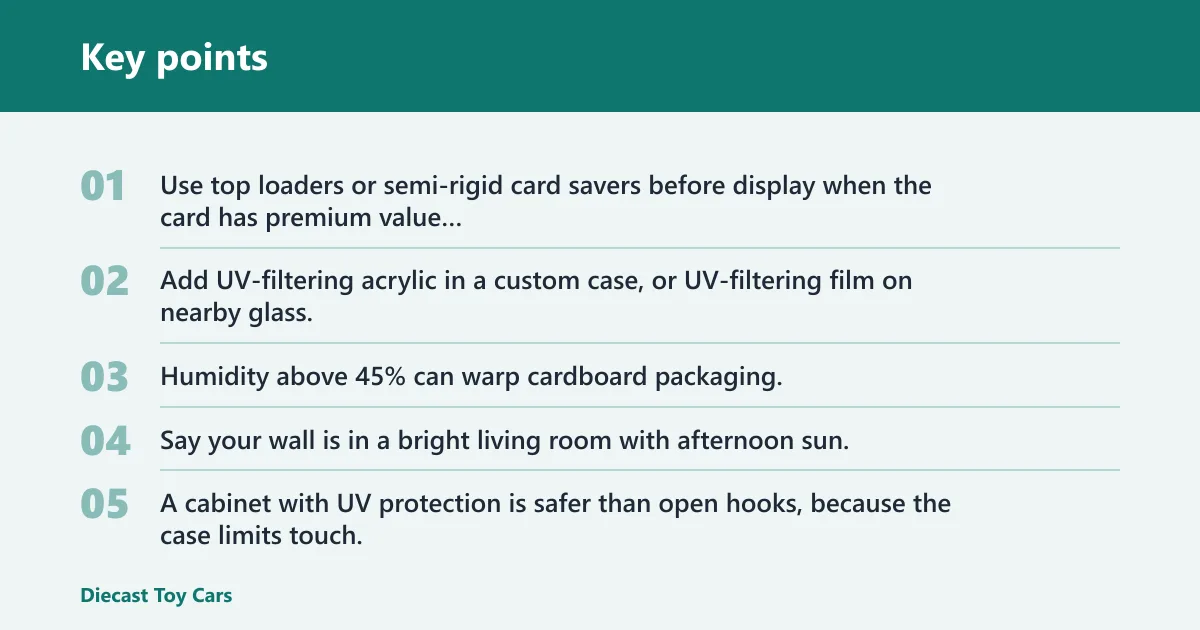
Use top loaders or semi-rigid card savers before display when the card has premium value or sharp corners worth preserving. Add UV-filtering acrylic in a custom case, or UV-filtering film on nearby glass, when the room gets strong daylight. Humidity above 45% can warp cardboard packaging, and a steady display microclimate is 35-45% relative humidity.
Say your wall is in a bright living room with afternoon sun. A cabinet with UV protection is safer than open hooks, because the case limits touch, dust, and glare. Suppose the room stays dry but the collection includes long cards and short cards together; a shelf with protectors keeps the rows flat without forcing the blister to tilt.
How do you install a pegboard display safely?
The safest pegboard setup uses studs, spacers, and hook spacing that keeps each card flat. Do not mount standard pegboard directly against drywall and expect the hooks to work correctly; the board needs clearance behind it. That spacing also helps you avoid blister pressure and card bend.
Install the board in the right order
- Find wall studs and mark them.
- Cut or place spacers or furring strips behind the pegboard.
- Fasten the pegboard into studs with 2½-inch wood screws.
- Check that the 1-inch grid spacing stays clear for your hook pattern.
- Set hooks 4-6 inches apart so the cards remain visible and do not crowd each other.
- Load the lightest cards first, then check for tilt, bounce, or edge contact.
Set hook depth and alignment
Hook depth should support the card without pushing the blister forward. Keep enough edge clearance that the card back does not rub the wall or neighboring hooks. If the card begins to bow, remove one card from that cluster and re-space the hooks before adding more.
How do you set up shelves or a cabinet?
Floating shelves work best when they are 3-4 inches deep and hold a single row of sealed Hot Wheels. An enclosed cabinet is safer for higher-value cards because it limits dust, touch, and accidental contact. The IKEA Detolf cabinet works with stepped rows or 2-inch acrylic risers to bring back rows into view.
Use lighting that does not heat the display
Install LED strips at 45-degree angles above shelves, with 4000K-5000K color temperature. That angle helps reduce glare on blisters and protector sleeves. Keep the light aimed at the cards, not straight at the glass, or reflections will hide details and make the display harder to read.
Control humidity inside enclosed cases
Put silica gel packets in enclosed displays and replace them on a regular schedule based on the packet manufacturer’s guidance; one competitor recommends quarterly replacement. If the case sits in a room that runs humid, monitor the room rather than the case alone. Cardboard warps above 45% relative humidity.
How do I display Hot Wheels on a wall without damaging the card?
Keep the card flat, avoid adhesive contact, and match the display to the card’s value. Standard cards can go on a pegboard or shelf, while premium cards are better inside a top loader or semi-rigid card saver before display. Never let the blister press against a hard edge or a tight protector corner.
Use protectors when the card matters more
A standard card top loader is 3×4 inches. That size is common for standard cards, but fit still varies by card shape, so check the manufacturer’s listing for your exact model of protector. For premium cards, a semi-rigid card saver gives better corner protection than a loose sleeve.
Protect the room, not only the card
Keep the display away from direct sun, and use UV-filtering film on nearby glass when the room has a bright window. One competitor recommends keeping displays at least 10 feet from windows. Treat that as a conservative room-planning guide, not a universal rule; glare and heat exposure matter more than the exact distance.
Common mistakes that damage cards
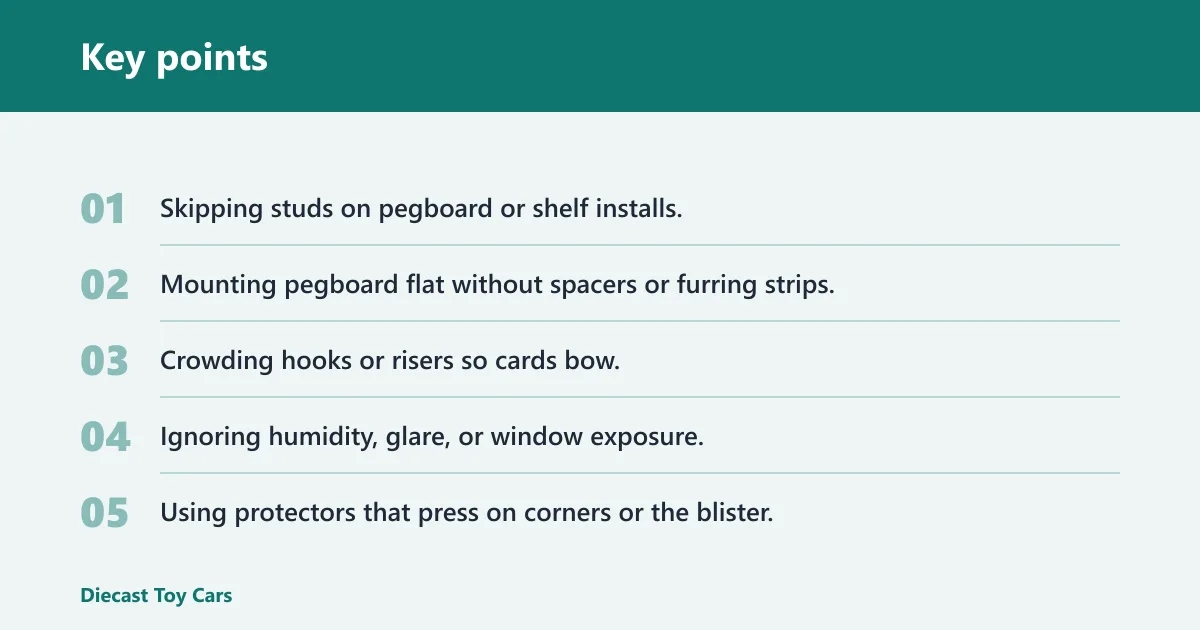
- Skipping studs on pegboard or shelf installs. The fix is to anchor to studs or use a cabinet that carries its own frame load.
- Mounting pegboard flat without spacers or furring strips. The fix is to leave clearance behind the board so hooks sit correctly.
- Crowding hooks or risers so cards bow. The fix is to leave space and recheck alignment after each row.
- Ignoring humidity, glare, or window exposure. The fix is to keep relative humidity near 35-45% and add UV protection where needed.
- Using protectors that press on corners or the blister. The fix is to confirm fit before hanging the card on the wall.
A common first-timer mistake is hanging three long cards on a shelf that is too shallow. The front edges slip forward, the cards lean, and the bottom corners start to curl. Move to a deeper support or a cabinet with stepped rows instead of forcing the fit.
Another common mistake is adding a tight top loader to a premium card and then squeezing it between hooks. The card looks straight for a day, then the corner pressure shows up. Use the right protector first, then space the wall hardware around that protector.
What lighting is safe for a Hot Wheels wall display?
LED lighting is the safest choice for most wall displays because it adds far less heat than older bulbs. That placement gives usable light while reducing glare on blisters and glass.
Keep reflections under control
If a display sits near a window or a glass cabinet door, test the viewing angle before you load the full wall. If you see strong reflections, change the light angle or move the light source farther from the face of the display. UV-filtering acrylic helps most when the cards are high value or the room gets bright daily light.
Frequently asked questions
What is the safest way to hang carded Hot Wheels on drywall?
Anchor the display into studs whenever possible. If you are using pegboard, mount it with 2½-inch wood screws and spacers or furring strips. For renters, a cabinet or shelf that uses fewer wall penetrations is usually easier to remove later.
Do I need protectors for carded Hot Wheels wall display?
For standard cards in a low-risk room, protectors are helpful but not mandatory. For premium cards, use a top loader or semi-rigid card saver before display. Protectors are most useful when the card will sit near light, airflow, or handling traffic.
How far should carded Hot Wheels be from windows and sunlight?
Keep them out of direct sun first, then reduce nearby glass exposure with UV-filtering film. One competitor recommends at least 10 feet from windows, but room layout matters more than a fixed number. A shaded wall with controlled light is safer than a bright wall across the room.
What kind of wall display works best for sealed Hot Wheels?
For sealed cars, a cabinet-style display is safest, especially for premium cards. Use the IKEA Detolf cabinet for stepped rows or acrylic risers, or choose a custom enclosed case with UV-filtering acrylic when light control matters most.
Can pegboard hold carded Hot Wheels safely?
Yes, if it is mounted to studs with 2½-inch wood screws and spaced off the wall with spacers or furring strips. Keep hooks 4-6 inches apart and check that the card sits flat without tilting. Pegboard is flexible, but it is not the lowest-risk option.
How do I keep Hot Wheels cards from bending on a wall?
Use full backing support, keep the load centered, and avoid tight protector corners. If a card starts to bow, reduce the number of cards on that hook or shelf section and re-space the layout. Humidity control matters too, because cardboard warps above 45% relative humidity.