Buying Online vs in Store: Which Is Better for Diecast?
Buying online usually gives you more listings to compare, better price checks, and easier access to scarce releases. Buying in store gives you direct condition checks and same-day possession, which matters for high-value pieces and boxed cars. Pick online for hard-to-find models; pick a shop when you want to inspect first. Choose poorly and you can overpay, miss defects, or lose a rare model while waiting on a return. This guide compares both channels by risk, condition, and diecast type.
| Factor | Buying online | in store | Winner |
|---|---|---|---|
| Selection | Wide range across sellers, eras, scales, and box conditions | Limited to local stock and what the shop has on hand | Buying online |
| Inspection certainty | Depends on photo quality, description accuracy, and seller honesty | You can check paint, windows, wheels, base, box, and card before paying | in store |
| Total cost | Can be lower on sticker price, but shipping, taxes, and returns add cost | May carry local price premiums, but no shipping fee | Tie |
| Shipping and damage risk | Carrier damage, crushed corners, and transit loss are possible | No transit damage after purchase | in store |
| Buyer protection | Can be strong if the platform supports card payments, PayPal, and disputes | Depends on the shop’s return policy and receipt rules | Buying online |
Selection and price discovery online
Buying online usually wins when you want breadth. Marketplace listings let you compare seller ratings, feedback volume, response speed, and return history before you commit, which matters when one missing detail can change a diecast’s value. Major platforms and payment providers also give you a paper trail if the item never arrives or is not as described: PayPal’s Purchase Protection, for example, covers eligible items that are significantly not as described or not received, and major card networks let you dispute unauthorized or problematic charges through the issuer process. That protection is strongest when the purchase stays inside the platform and the payment method preserves dispute rights.
Online also lets you compare prices across many listings fast. That helps with common loose cars, boxed mint pieces, and older releases where local stock is thin. For collectors who already know the exact casting or variant they want, online search can also surface packaging variants, card art changes, and seller notes that would never appear on a shop shelf.
Inspection and instant certainty in store
In store wins when the model’s condition matters more than the hunt. You can inspect paint chips, window scuffs, base markings, wheel alignment, corner crush on the box, and blister card wear before money changes hands.
A brief collector checklist helps: hold the car under angled light, check the roof and hood edges for micro-chips, look at the base for swap marks, spin the wheels for wobble, and inspect corners on boxed or carded pieces. In practice, that catches defects online photos often miss, especially on glossy finishes and dark paint. A common failure case is a listing that looks clean straight-on but hides a front-corner chip or a bent axle that only appears when the car is tilted; another is a carded piece with a slightly lifted blister edge that is invisible in a single front photo.
You also take the item home immediately. For a collector who wants to avoid shipping damage, that certainty has real value.
How the diecast type changes the choice
The right channel changes with the item type. Loose cars are easier to inspect in person, boxed mint cars need packaging checks, rare limited editions need trust and proof, and bulk lots usually favor the channel that gives the best total cost after shipping and fees.
Do not treat all diecast the same. A near mint loose model with a few base marks is a different purchase from a carded release with a clean front but a crushed corner. For condition-driven decisions, related guidance like diecast condition grading and packaging terminology can help you separate cosmetic wear from collector-grade flaws.
Diecast buying matrix
The matrix below uses a weighted score to make the comparison more defensible than a simple opinion split. Each scenario is scored on five criteria: selection (30%), inspection certainty (25%), shipping risk (20%), total cost (15%), and return ease / dispute leverage (10%). Scores run from 1 to 5, with 5 being best for the buyer. The recommended channel is the one with the higher weighted total after factoring in what matters most for that scenario.
| Buyer scenario | Buying online score | in store score | Recommended channel |
|---|---|---|---|
| Common loose car | Selection: 5, inspection: 2, shipping risk: 3, total cost: 4, return ease: 3 | Selection: 2, inspection: 5, shipping risk: 5, total cost: 3, return ease: 4 | in store |
| Boxed mint car | Selection: 5, inspection: 3, shipping risk: 2, total cost: 4, return ease: 3 | Selection: 2, inspection: 5, shipping risk: 5, total cost: 3, return ease: 4 | Buying online |
| Rare limited edition | Selection: 5, inspection: 3, shipping risk: 2, total cost: 3, return ease: 2 | Selection: 1, inspection: 4, shipping risk: 5, total cost: 2, return ease: 3 | Buying online |
| Bulk lot | Selection: 5, inspection: 2, shipping risk: 3, total cost: 4, return ease: 2 | Selection: 3, inspection: 4, shipping risk: 5, total cost: 3, return ease: 3 | Buying online |
Common loose car
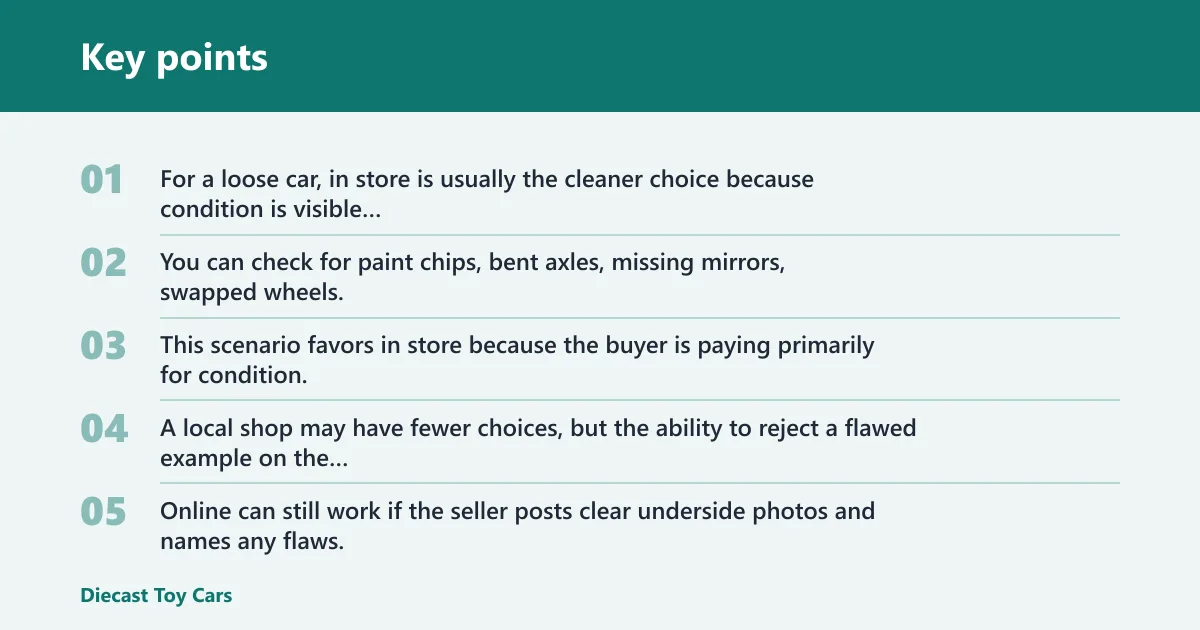
For a loose car, in store is usually the cleaner choice because condition is visible right away. You can check for paint chips, bent axles, missing mirrors, swapped wheels, and cracked windshields before you pay.
This scenario favors in store because the buyer is paying primarily for condition, not for search breadth. A local shop may have fewer choices, but the ability to reject a flawed example on the spot is more valuable when the model is common and easy to replace. Online can still work if the seller posts clear underside photos and names any flaws, but a common loose model rarely needs the extra search range that online offers.
Boxed mint car
Buying online is often better for boxed mint cars because the main goal is finding a clean example, not just any example. The wider pool helps you compare box corners, blister clarity, seal condition, and whether the listing actually matches the stated grade.
This scenario favors online because boxed mint pieces are often judged by small differences that local inventory cannot reliably match. A local shop can still be best if the box is open for inspection and you want certainty before purchase. For sealed stock, however, the online market usually offers more choice, and buyer-protection tools can help if the item arrives not as described.
Rare limited edition
Buying online is usually safer for rare releases because the market is broader and the seller can provide more detail than a local shelf can. The risk shifts from selection to proof: you need accurate photos, strong feedback, and a payment method with buyer protection.
This scenario favors online because rare releases are often a search problem first and a condition problem second. If the exact piece is not in a nearby shop, in store offers no real advantage. In addition, card-funded purchases and PayPal-style dispute systems matter more here because a rare item can be expensive enough that a missing shipment or a concealed defect justifies a formal claim. For storage and later resale, add safe shipping for collectibles and box/card preservation to your checklist.
Bulk lot
Buying online usually works better for bulk lots because you can find larger lots, compare unit cost, and combine shipping on multiple cars. The downside is that hidden damage, duplicate pieces, or mixed condition grades are more likely.
This scenario favors online when the buyer values volume and cost efficiency over per-item certainty. In store can be useful for a single lot if the shop allows a close look before purchase. Even then, the local selection is often too small to match online volume. When buying mixed lots, be especially alert for reseals, repacks, and parts swaps; spotting reseals/repacks is one of the most useful defenses against bad lots.
Is it better to buy diecast cars online or in store?
Buying online is better when selection, price comparison, and hard-to-find listings matter most. in store is better when you need to inspect condition before paying and want the car in hand immediately. The better choice depends on whether the model is common, boxed, carded, rare, or part of a lot.
That split matters because the same diecast can carry very different risk. A loose car can hide paint chips and wheel issues; a carded model can hide corner crush or a warped blister that pictures do not fully show.
Selection and availability
Online marketplaces have the clear edge on selection. You can filter by scale, manufacturer, year, casting, packaging, and condition, then compare several sellers at once.
Brick-and-mortar hobby stores usually have narrower inventory. That limits choice but makes the available items easier to verify.
Inspection and certainty
In store is stronger when the buyer wants certainty on the spot. You can rotate the car under light, look at the underside, check wheel fit, and inspect the original box or blister card for wear.
That matters for mint and near mint examples, where a small defect can change collector value. Online photos help, but they do not remove uncertainty.
What are the risks of buying diecast cars online?

The main risks are misleading photos, hidden condition issues, shipping damage, and weak seller behavior. Online listings can omit paint chips, window scuffs, bent axles, crushed corners, or swapped parts, and some sellers use stock images or stolen photos that do not show the exact item.
Those risks can be managed, but not ignored. A strong listing should show close-ups, underside photos, wheel and base photos, and clear notes on flaws. If the seller is vague, remember that major marketplaces and card issuers generally rely on evidence: the listing, the tracking history, and the communication trail.
Seller reputation and listing evidence
Check the seller’s feedback score, number of sales, specialization in diecast, response speed, and return history. A seller who handles many diecast listings and answers questions quickly is usually easier to trust than a general seller with sparse history.
Listing evidence matters just as much. If the description is vague, the photos are blurry, or the item appears to be copied from another listing, the risk rises fast.
Payment protection and disputes
Use a credit card or PayPal buyer protection when possible. Those channels usually offer dispute tools, while wire transfers give you little practical recourse if the item never arrives or the description is wrong. Major card providers also give consumers a formal dispute path when a merchant fails to deliver or charges incorrectly, but the buyer still needs to keep records and act within the issuer’s time limits.
Know the chargeback window and the platform dispute process before you buy. If the seller resists returns or the platform limits complaints, your protection drops. eBay’s Money Back Guarantee, for example, gives buyers recourse for items that do not arrive or do not match the listing, while PayPal and card issuers each impose their own eligibility and evidence requirements.
Shipping and handling
Shipping can change the risk profile more than many buyers expect. Carrier choice, insurance, and signature on delivery matter for rare or expensive pieces, especially when the original box or blister card must arrive without crush damage.
For valuable collectibles, it is smart to request rigid outer packaging, bubble wrap that does not press on the card or blister, adequate void fill, and tracking with delivery confirmation. Insurance is useful when replacement value is high, and signature service can reduce porch theft risk. Those practices do not guarantee perfection, but they strengthen a claim if the parcel arrives damaged or disappears in transit.
Combined shipping can lower the average cost per item in a bulk purchase. Without it, multiple small orders can erase the price advantage of buying online.
Can you inspect a diecast car better in a store than online?
Yes. In store gives you direct access to the item, so you can inspect paint, wheels, windows, base marks, and packaging before payment. Online can show a lot, but it cannot fully replace hands-on inspection for defects that only appear under different angles or light.
That advantage is strongest for condition-sensitive buyers. It matters less when you only need a common loose car and more when a mint box, perfect card, or pristine finish is the goal.
What to check on the body and base
Look for paint chips, rubbing marks, uneven tampo placement, missing parts, bent axles, and wheel wobble. Check the underside for casting marks, swapped bases, and damage that can hide in seller photos.
A common first-timer mistake is to inspect only the side view. Many flaws show up on the roof, hood edge, or base.
What to check on the box or card
For boxed models, look for corner crush, tears, taped repairs, water marks, and seam wear. For carded releases, inspect the blister card, bubble seal, and any warp in the card back.
If the item includes shrink wrap, check whether it is original or added later. Fresh wrap can hide problems, but it can also create its own handling marks.
How staff expertise helps
Good hobby-store staff can help you spot a casting variant, identify a repaint, or point out packaging issues that are easy to miss. That local knowledge is useful for collectors who are learning what separates a near mint piece from a truly clean one.
Still, expertise does not fix a thin shelf. If the store has only a few options, inspection cannot make up for limited inventory.
How do price, shipping, and returns change the total cost?
Sticker price is only part of the bill, since shipping, taxes, local price premiums, platform fees, and return friction can make a lower online listing cost more than a higher in-store tag.
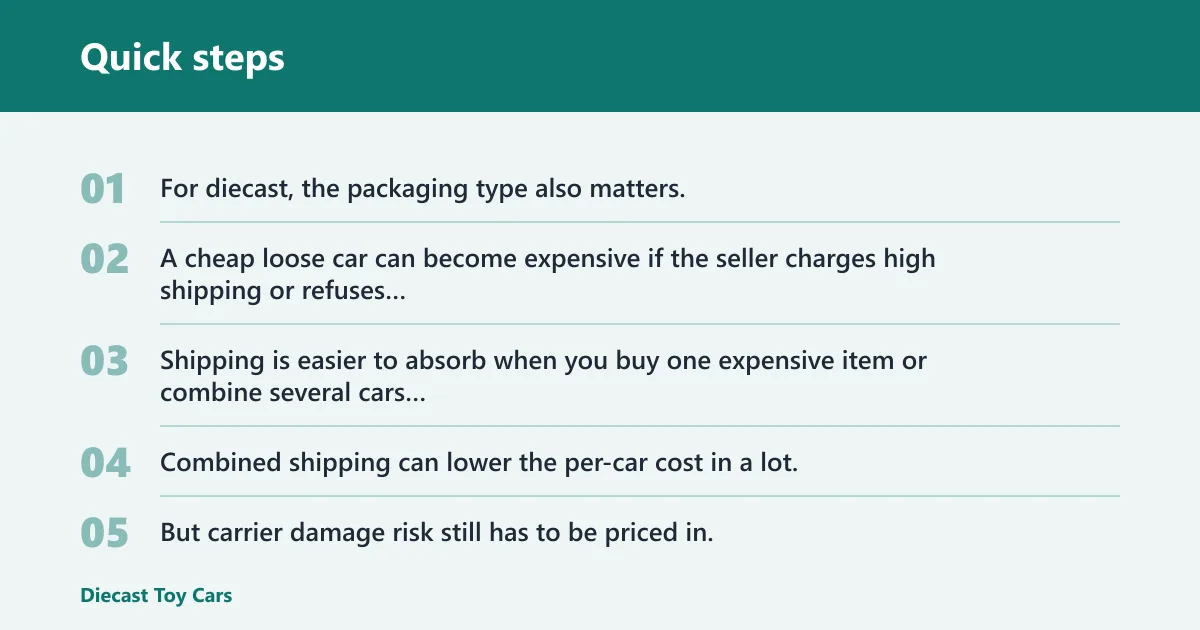
For diecast, the packaging type also matters. A cheap loose car can become expensive if the seller charges high shipping or refuses easy returns.
Shipping cost and combined shipping
Shipping is easier to absorb when you buy one expensive item or combine several cars from the same seller. Combined shipping can lower the per-car cost in a lot, which is why bulk online orders may make more sense than one-off purchases.
But carrier damage risk still has to be priced in. A rare boxed item may need extra packing, insurance, and signature delivery, all of which add cost.
Taxes, local premiums, and platform fees
Online buyers often pay sales tax at checkout, and some marketplaces add service fees or higher shipping charges. In store, the sticker price can be higher because the shop covers overhead and local market demand.
That is why a simple price comparison is not enough. The real comparison is total landed cost against the chance of receiving the item in the condition you expect.
Return policy and refund friction
A return policy matters more when the item is expensive, condition-sensitive, or rare enough that a bad purchase is hard to replace. If returning a listing means paying return shipping, waiting for a refund, and missing the next available piece, the nominal savings may not be worth it.
In store returns can be easier if the shop is local and keeps clear receipt rules. Even then, the return policy should be checked before you buy.
Choose Buying online if… / Choose in store if…
Choose Buying online if you want the widest selection, need to compare many listings, or are buying a rare limited edition that local stores are unlikely to carry. It also fits bulk lots better, especially when combined shipping lowers the per-item cost.
Choose in store if you want to inspect a loose or boxed car before paying, care most about immediate certainty, or are buying a piece where box corners, paint chips, and window scuffs would change your decision. It is also the better pick when you want the item today and do not want shipping risk.
Frequently asked questions
What should I check before buying a diecast car in person?
Check the paint, windows, wheels, base, and any missing parts first. Then inspect the box or card for corner crush, tears, seal wear, or blister damage if the model is packaged. Ask whether the shop has a return policy in case a defect is missed.
Which option is safer for rare or limited-edition diecast cars?
Buying online is usually safer for rare or limited-edition pieces because the selection is broader and you can screen sellers by feedback, sales volume, and return history. The key is to use payment protection and insist on clear photos before you commit.
How do shipping costs change the value of buying diecast online?
Shipping can erase a price advantage fast, especially for low-cost cars. If the seller offers combined shipping, the total can improve on larger orders, but single-item shipping, insurance, and signature fees can push the final cost above a local shop’s price.
When is a return policy more important than the purchase price?
A return policy matters more when the diecast is expensive, boxed, carded, or rare enough that a flaw is costly to absorb. It also matters when photos are weak or the seller has limited feedback, because a cheap listing is not cheap if you cannot recover your money easily.
Should I buy diecast cars online if I want the original box?
Yes, if the listing shows the original box clearly and the seller has strong photos and a good return record. Ask for corner shots, seal details, and any wear notes. For boxed mint cars, the box is part of the value, so shipping protection matters as much as the car itself.
Sources
- PayPal Help Center: Purchase Protection and dispute eligibility for items not received or not as described.
- Visa and Mastercard cardholder dispute guidance: chargeback basics, time limits, and documentation requirements.
- eBay Help: Money Back Guarantee and item-not-received / item-not-as-described claim process.
- USPS, UPS, and FedEx shipping guidance: tracking, insurance, and signature confirmation options for higher-value parcels.
- Marketplace seller help pages: return policy settings, listing photo requirements, and condition-description expectations.