Why Are Some Diecast Brands So Expensive?
Diecast brands cost more when tooling, licensing, paint, assembly, low production volumes, freight, and retailer markup all stack on top of one another. If those costs are real, the price makes sense. Miss the breakdown and you can overpay for branding or reject a model built to a higher standard. This guide shows how each cost layer changes the sticker price and how to separate value from markup. For adjacent help, see the scale guide, the diecast brand comparison, the valuation guide, and the licensing explainer.
Why do diecast brands cost more?
Diecast brands cost more when tooling, licensing, paint, assembly, low production volumes, and retailer markup add up. If those costs are real, the price makes sense. Miss the breakdown and you can overpay for branding or reject a model built to a higher standard. This guide shows how each cost layer changes the sticker price and how to separate value from markup.
Price is a stack of separate costs
Two models of similar size can land at very different retail prices because no single factor sets the final tag. A 1:64 model with simple graphics, no licensed badge, and blister packaging can cost far less than a 1:64 model with licensed nameplates, multiple paint passes, metal chassis parts, and a display box.
The same logic applies across scales. A 1:18 model can look expensive because it uses more material, more labor, and more parts, but a carefully engineered 1:64 casting can still cost more than a basic 1:18 piece if the tooling, licensing, and finish are heavier.
When a higher price is real cost, not branding alone
A higher price is easier to justify when it matches specific costs: complex mold work, paid brand rights, more decoration, tighter assembly, and lower production volume. A high tag is weaker evidence when the model has simple paint, few parts, and plain packaging but still sits far above comparable releases.
| Cost line | Estimated share of retail price | Strongest pressure by brand tier |
|---|---|---|
| Tooling | 10%–20% | Budget: low; Mid-tier: medium; Premium: high |
| Licensing | 3%–10% | Budget: low if unlicensed; Mid-tier: medium; Premium: high |
| Materials | 8%–18% | Budget: medium; Mid-tier: medium; Premium: high |
| Labor | 10%–20% | Budget: low; Mid-tier: medium; Premium: high |
| Decoration | 8%–16% | Budget: low; Mid-tier: medium; Premium: high |
| Packaging | 3%–8% | Budget: low; Mid-tier: medium; Premium: medium to high |
| Freight | 4%–10% | Budget: medium; Mid-tier: medium; Premium: medium |
| Wholesale margin | 15%–30% | Budget: high; Mid-tier: high; Premium: medium |
| Retailer margin | 20%–40% | Budget: high; Mid-tier: high; Premium: high |
This is a price stack, not a fixed formula. The shares move with scale, finish level, sales volume, and channel. A collector release with heavy tampo printing and a display base can shift money out of tooling and into decoration, packaging, and labor.
What the numbers are based
These ranges are consistent with how diecast and broader consumer-goods manufacturing costs are usually discussed in industry reporting: tooling must be amortized over the run, royalties can be charged per unit, import freight moved sharply during the 2020–2022 shipping cycle, and downstream channel margins widen as products move from maker to distributor to retailer. Industry and trade sources routinely note that short runs raise per-unit tooling burden, retail gross margins often land in the high 20s to 40s for toys and collectibles, and freight can materially alter landed cost on small, heavy goods. See the licensing explainer and valuation guide for the same economics from a collector’s angle.
What makes tooling so expensive?
Tooling is expensive because a diecast model starts with steel molds, and steel tooling takes machining time, design work, fit checks, and revisions. The cost is paid up front, before a single box is sold, so a low run has to carry more of that bill per unit than a long run does.
Steel molds and machining time
The mold is the heart of the cost. Detail such as sharp grille mesh, thin mirror stalks, separate lamp buckets, and deep undercuts needs more cutting time and more careful engineering. That adds labor before production even starts.
More detail can also mean more mold inserts, more slides, and more polishing work on the cavity surfaces. Those choices help the casting look crisp, but they also raise the tooling bill.
Multi-cavity versus single-cavity tooling
Multi-cavity tooling can spread output across more parts per cycle, which helps lower unit cost at higher volumes. Single-cavity tooling is slower and often used when a maker expects lower demand or a more complex shape that is harder to duplicate cleanly.
For a premium release, a maker may accept a slower tool if the body shape, opening panels, or fine trim lines would suffer in a faster setup. That trade keeps the model accurate, but it raises the cost per piece.
How volume changes the tooling bill
Tooling cost is amortized across the production run. If a mold costs a large sum and the run is small, each model carries a heavier share of that cost. A mass-market run can spread the same mold cost across far more pieces, which lowers the tooling portion in the retail price.
Suppose two 1:64 models use similar steel tooling. One is produced in a very large batch for a retail chain, while the other is sold as a numbered run of a few thousand units. The second model has to recover the mold cost from far fewer buyers, so the retail price rises even if the body shell is similar.
How do licensing fees affect diecast car prices?
Licensed models usually cost more because the maker must pay for automaker approval and for the right to use the badge, name, and sometimes specific trim details. That cost may be a per-unit royalty, a flat contract fee, or a mix of both. Unlicensed lookalikes avoid that layer, so they can price lower.
Approval, names, and royalty structure
Official approval can add design review steps before production. The maker may need sign-off on proportions, paint colors, logos, and packaging language. That process adds time and can limit how a model is sold or described.
Royalty terms vary. Some agreements charge per unit; others use contract terms tied to sales volume or a broader licensing deal. Either way, the automaker’s fee sits on top of tooling and production costs.
Why licensed models usually cost more than unlicensed ones
A licensed model does not only pay for the badge. It often also carries stricter art review, more exact trim calls, and extra packaging controls. Those steps can push up decoration and labor as well as the direct rights cost.
How scale changes the price
Scale matters because larger models usually use more material and more labor. A 1:18 model normally needs more metal, glass, interior detail, and assembly time than a 1:64 model, while 1:43 sits between them for size and cost. Small scale can still be expensive if the detail level is high enough.
1:64 versus 1:43 versus 1:18
At 1:64, a maker can keep price lower by using fewer parts and simpler decoration. At 1:43, the model often allows more visible detail and a more complete interior, which raises material and labor costs. At 1:18, moving parts, detailed chassis work, and larger boxes usually raise the total further.
When small scale still gets expensive
Small does not always mean cheap. A 1:64 collector piece with metal mirrors, rubber tires, photo-etch trim, multiple paint layers, and a licensed livery can cost more than a plain 1:43 model because the finishing work and rights cost dominate the size advantage.
What raises finish and assembly costs
Finish and assembly costs rise when a model uses more materials, more parts, and more decoration steps. Metal bodies, plastic inserts, rubber tires, glass, chrome, and photo-etch details each add cost in a different way. Paint and tampo work can add as much cost as the shell itself on a high-detail release.
Materials and finish parts
Die-cast metal is only part of the build. Many models also use plastic for interiors and trim, rubber for tires, clear plastic or glass-like inserts for windows, chrome plating for brightwork, and photo-etch for fine emblems or grilles. Each material adds sourcing, handling, and fit work.
Paint quality matters too. Multiple coats, color sanding, polishing, and a cleaner clear layer take time. A dull finish can hide flaws; a high-gloss finish exposes them, so the maker has to work harder to keep the surface even.
Paint, tampo printing, and decoration count
Decoration is a major cost driver. Multi-pass tampo printing, decals, masks, and separate color layers all increase finishing time. A model with five or six distinct graphics steps costs more to decorate than one with a single color and a small logo.
A common first-timer mistake is to compare two models of the same size and miss the decoration count. A plain road car with one livery can be cheap to finish, while a race car with number panels, sponsor marks, stripes, and window text needs far more setup and inspection.
Opening parts and working features
Opening doors, hood, and trunk add hinges, tolerances, and assembly steps. Steering and suspension features add more pieces and more chances for fit variation. Those parts can make a model feel more complete, but they also raise labor cost and can reduce consistency from unit to unit.
How do collectors evaluate build quality in person?
Collectors and reviewers usually judge a model by what the eye and fingers catch first: even panel gaps, clean tampo registration, wheel fit, hinge alignment, paint depth, and whether the model sits squarely on its tires. Those are the small production details that separate a model that feels engineered from one that simply looks good in photos.
Panel gaps, tampo registration, and wheel fit
Panel gaps should be even from side to side and front to rear. If a hood, door, or engine cover sits proud on one edge, that usually signals loose tolerances or hinge stress. Tampo registration matters just as much: sponsor text, pinstripes, and badges should align cleanly without blur, shadowing, or offset layers.
Wheel fit is another tell. The tires should sit centered in the arches, with no obvious rake mismatch or axle drift. On premium 1:43 and 1:18 pieces, collectors often notice whether the wheel barrels are square and whether the tires rub against brake hardware or bodywork.
Hinge quality, paint depth, and common failure modes
Good hinges open smoothly without slop, binding, or visible twisting. Cheap or over-tight hinges can chip paint around the mount points or leave doors that never close flush. Paint depth matters because a richer clear coat can make body lines look crisper, but thick paint can also soften edges or hide seam work if the surface was not prepared well.
Common failure modes include mirror stalks that snap during packaging, brittle antennae, loose side mirrors, roof parts that do not seat correctly, and chips at sharp edges where the body meets the base. On high-detail models, the most expensive-looking castings are sometimes the most fragile, so collectors often inspect the box-fresh model before deciding whether it is a display piece or a handling piece.
What makes a brand overpriced?
A brand is overpriced when the sticker price is far above the model’s actual casting quality, finish, and feature count. Reputation matters, but it should not hide weak paint, rough seams, soft details, or a simple body shell wrapped in a premium-looking box.
Brand reputation versus actual build quality
Budget brands, mid-tier brands, and premium brands often price differently because buyers expect different standards. That said, brand name alone does not guarantee better casting, cleaner tampo work, or tighter assembly. A premium logo can sit on a model that is only modestly better than a cheaper rival.
Packaging, freight, and channel markup
Packaging can add real cost. Window boxes, collector trays, display bases, foam inserts, and printed sleeves cost more than a simple blister pack. Freight adds another layer, especially for heavier 1:18 pieces or boxed collector items. Longer lanes, fuel surcharges, and container spikes all translate into higher landed cost.
Then come wholesale margin, retailer margin, and marketplace fees. Those charges can make a model look expensive long before the maker’s own production cost is visible. Online resale can push the price even higher when supply is thin.
How to judge value for different uses
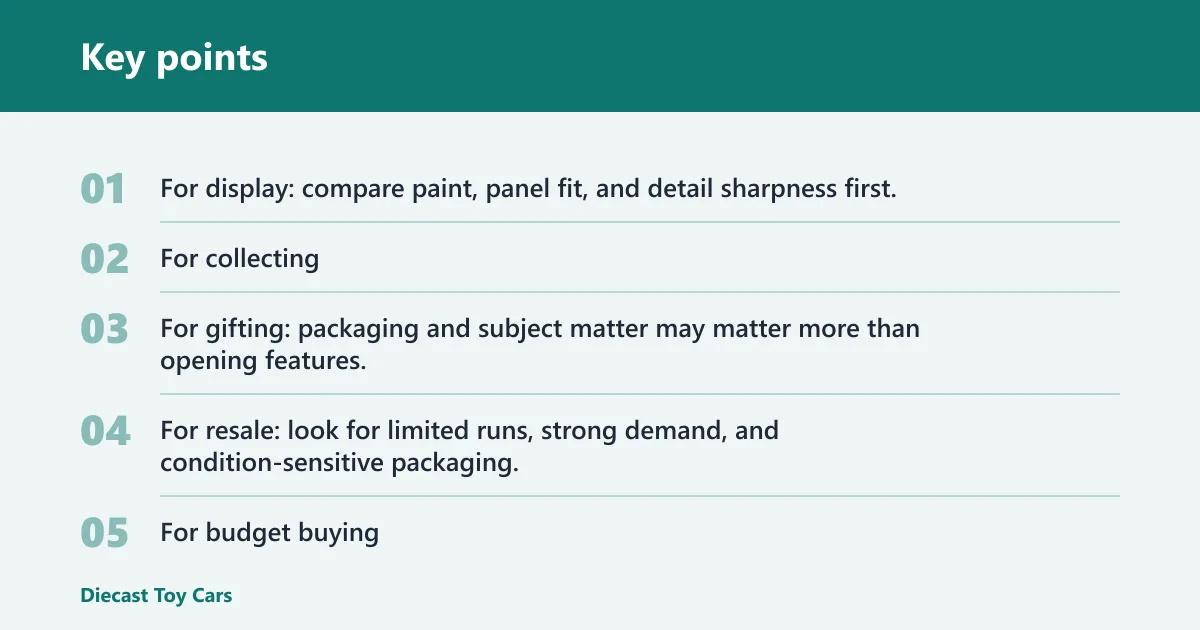
- For display: compare paint, panel fit, and detail sharpness first.
- For collecting: check run size, license status, and whether the finish matches the price tier.
- For gifting: packaging and subject matter may matter more than opening features.
- For resale: look for limited runs, strong demand, and condition-sensitive packaging.
- For budget buying: compare the same scale, same license status, and similar feature count before judging price.
Picture two 1:64 models on the same shelf. One has a plain blister, simple wheels, and no license; the other has a licensed badge, metal chassis parts, multi-color tampo work, and a display box. The second model costs more for clear reasons, while the first may still be the better buy if you only want a loose display piece.
How do budget, mid-tier, and premium brands compare?
This is where the diecast price stack becomes visible in the real market. A budget brand may keep the body accurate and the graphics simple, while a premium brand spends more on tooling refinement, paint depth, opening parts, and quality control. The best buy is not always the most expensive one; it is the one whose execution matches the asking price and your use case.
| Tier | Typical examples | Usual strengths | Common tradeoffs | Best fit |
|---|---|---|---|---|
| Budget | Maisto, many basic GreenLight releases | Accessible price, broad selection, easy display value | Thicker paint, simpler interiors, less consistent wheel fit, more visible mold lines | Loose collecting, gifting, entry-level display |
| Mid-tier | Mini GT, Auto World, select GreenLight lines | Sharper tampo work, better stance, stronger subject focus, good value per dollar | Still limited on opening parts or ultra-fine hardware; some runs show finish variation | Collector shelves, themed series, value-focused serious collecting |
| Premium | Kyosho, Autoart, higher-end specialty releases | Paint depth, finer surface detail, better hinge action, tighter proportions, more convincing trim | Higher price, more fragile parts, longer wait times, less forgiving quality expectations | Showcase display, advanced collecting, detail-first buyers |
Real-world examples help here. Maisto often competes on accessibility and broad availability, while GreenLight can be excellent when the subject and license are what you want, especially in a themed collection. Mini GT has built a strong reputation for crisp 1:64 execution and strong stance. Auto World is often chosen for period-correct American subjects. Kyosho and Autoart sit closer to premium expectations, where the buyer is paying for refinement, finish, and deeper parts accuracy rather than only size or brand recognition.
Frequently asked questions
Why are diecast cars so expensive?
Diecast cars are expensive when several costs stack at once: tooling, licensing, paint, assembly, packaging, freight, and retail margin. A model can look simple from the outside and still carry a high share of up-front mold cost, especially if the production run is short.
Are diecast cars worth anything?
Some are worth more than their original retail price, but only when demand, condition, brand, and run size line up. Limited editions, sought-after castings, and sealed packaging can hold value better than mass-market pieces. Most models are worth what a buyer will pay now, not what the box once cost.
Is die casting expensive?
Yes, it can be. The process needs metal, molds, machining, finishing, and assembly, and the mold cost is paid before sales begin. It becomes more expensive when the part design is detailed or when the run is too small to spread that cost across many units.
What drives the price difference between 1:64 and 1:18 diecast models?
1:18 models usually cost more because they use more material, more detailed interiors, more assembly steps, and larger packaging. A 1:64 model can still be pricey if it has heavy decoration or a paid license, but the larger scale usually carries the higher base cost.
How can I tell if a diecast brand is overpriced?
Compare the model against others in the same scale and feature class. If the price is high but the casting is plain, the decoration count is low, and the packaging is basic, the premium may come from brand name or channel markup rather than build quality.
Sources
- U.S. Small Business Administration, guidance on pricing, overhead, and margin structure for physical goods.
- U.S. International Trade Commission and Customs trade guidance on import valuation, duties, and landed cost.
- Automotive licensing and brand-rights explainers from major licensing agencies and industry trade publications.
- Industry reporting on container freight volatility and consumer-goods supply chain costs during 2020–2024.
- Retail and toy industry reporting on gross margin ranges for mass-market collectibles and specialty hobby goods.
- Collector and review standards commonly used in diecast inspection: panel fit, tampo registration, wheel alignment, hinge function, and paint finish consistency.