
What Is the Difference Between 1:24 and 1:25 Scale?
1:24 models are 4.17% larger than 1:25 models in every linear dimension, so a 6-inch 1:25 car becomes about 6.25 inches at 1:24. Miss that gap, and mixed displays can look slightly off beside figures, garage scenes, and true-to-scale accessories. This guide shows how the ratio works, how big the difference is, and when 1:24 and 1:25 can sit together on one shelf.
Quick answer: 1:24 is 4.17% larger than 1:25, usually about 0.3 inch longer for common cars, and often safe to mix on shelves when the display is not tightly scale-matched.
- Scale charts
- Diecast size guide
- Display case sizing
- 1:24 model category
How the size difference shows up
1:24 means the model is 1/24 the size of the real vehicle. 1:25 means the model is 1/25 the size of the real vehicle. That one-step change makes 1:24 slightly larger in every linear dimension, so the gap shows up in length, width, and height, not only overall volume.
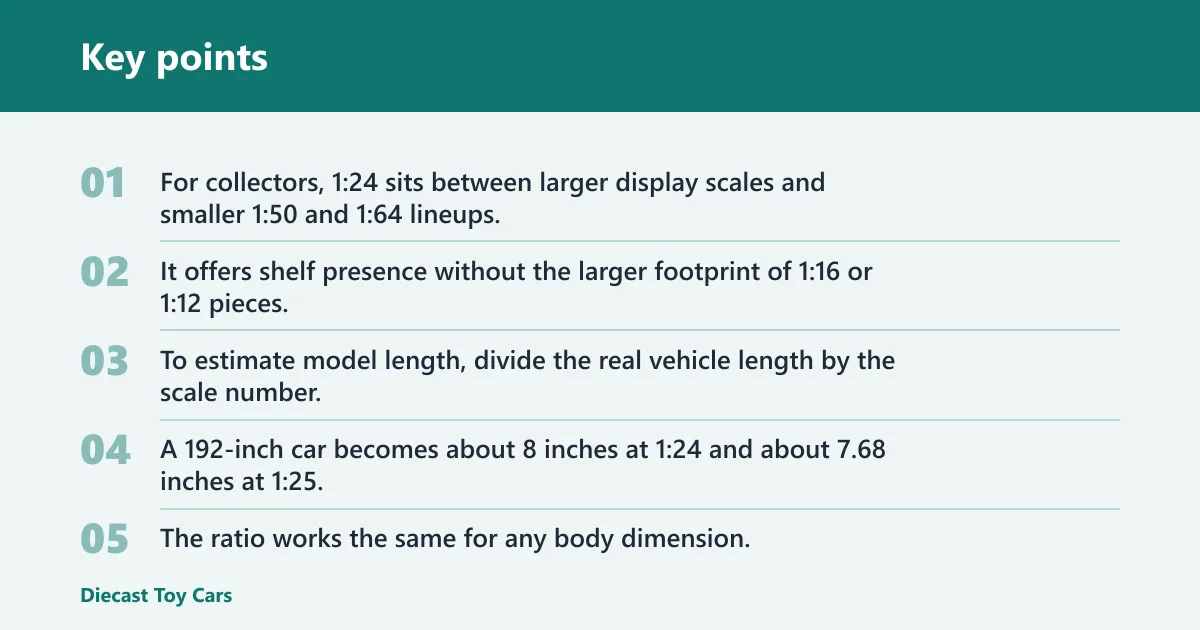
For collectors, 1:24 sits between larger display scales and smaller 1:50 and 1:64 lineups. It offers shelf presence without the larger footprint of 1:16 or 1:12 pieces, which is why many collectors use it for detailed display models and room-friendly cabinets.
How scale ratio turns a full-size car into inches
To estimate model length, divide the real vehicle length by the scale number. A 192-inch car becomes about 8 inches at 1:24 and about 7.68 inches at 1:25. The ratio works the same for any body dimension, so the same proportional gap appears in roof height, wheelbase, and overall stance. This is standard scale-model arithmetic: prototype size ÷ scale denominator = model size.
The 1:24 and 1:25 difference is small, but it is not imaginary. By linear math, 1:24 is 4.17% larger than 1:25. That is the figure that matters when you park two models side by side or place them beside a figure, tool cart, or garage wall.
Scale comparison table
| Real vehicle example | Full-size length | 1:24 length | 1:25 length | Difference | Percent difference |
|---|---|---|---|---|---|
| Compact car | 174 in | 7.25 in | 6.96 in | 0.29 in | 4.1% |
| Sedan | 194 in | 8.08 in | 7.76 in | 0.32 in | 4.1% |
| Pickup or SUV | 210 in | 8.75 in | 8.40 in | 0.35 in | 4.1% |
That table shows the practical pattern. The percentage stays the same, but the absolute inch gap grows as the real vehicle gets longer. A compact car leaves a smaller visible gap than a pickup or full-size SUV, even though the ratio difference never changes. The example lengths are representative of common vehicle-size classes, and the scale math is direct division from the published prototype dimensions.
How much bigger is 1:24 than 1:25?
1:24 is about 4.17% larger in linear dimensions than 1:25. That means the actual inch difference depends on the real vehicle length: longer cars produce a larger visible gap. On a short compact car, the difference can be under a third of an inch. On a long truck or SUV, it moves closer to a third of an inch or more.
Why the gap grows with longer vehicles
The scale ratio stays fixed, but the starting length changes. A 174-inch car and a 210-inch truck both keep the same 1:24-to-1:25 percentage difference, yet the longer body multiplies that percentage into a bigger absolute gap. That is why the mismatch looks more obvious on long pickups, vans, and SUVs.
Using the standard percentage-difference formula, the linear gap between 1:24 and 1:25 is about 4.1% to 4.2%, depending on whether you round to one or two decimal places. The same result applies to width, height, and length because the ratio changes uniformly across the model.
Say your shelf holds a 1:24 coupe and a 1:25 sedan of similar size. The difference may look fine if they are separated by a few inches and not parked nose-to-nose. Add a scale fuel pump, a human figure, and a garage door, and the mismatch becomes easier to spot because the accessories give your eye a fixed reference.
Will 1:24 and 1:25 fit the same display case?
Often, yes. Many cases, shelves, and acrylic boxes will accept both scales, because the size gap is only around 4.17% in linear dimensions. The real question is not whether they fit at all, but whether the extra width, length, and height of 1:24 leaves enough breathing room for doors, mirrors, and accessory parts.
Shelf depth and case fit
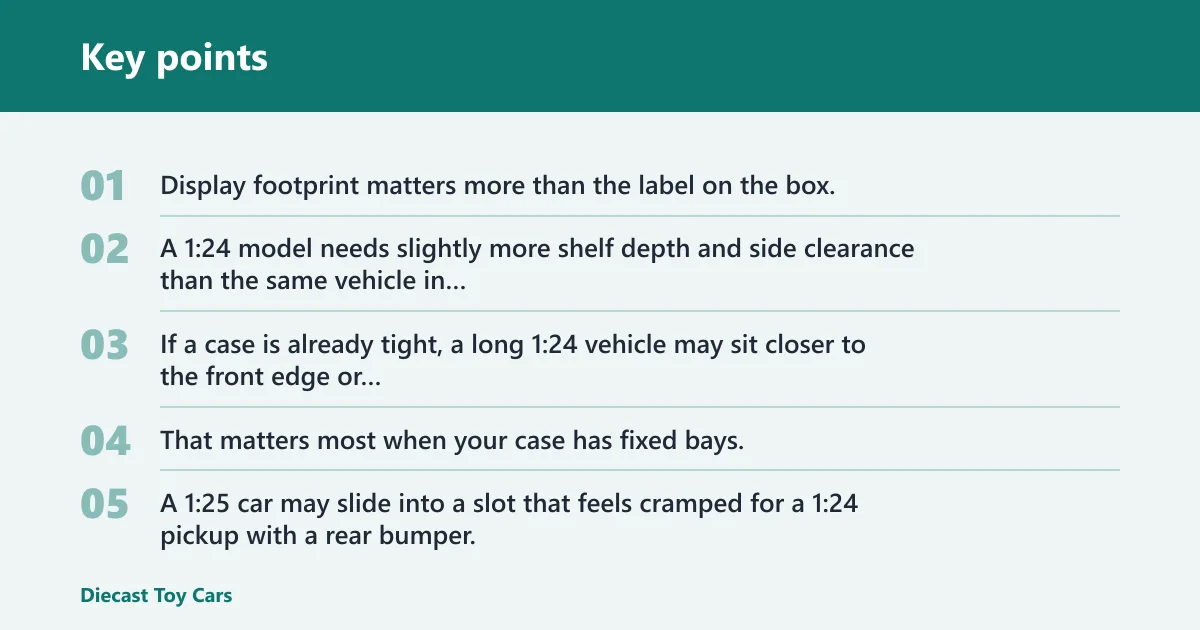
Display footprint matters more than the label on the box. A 1:24 model needs slightly more shelf depth and side clearance than the same vehicle in 1:25. If a case is already tight, a long 1:24 vehicle may sit closer to the front edge or touch the back wall sooner than its 1:25 version.
That matters most when your case has fixed bays. A 1:25 car may slide into a slot that feels cramped for a 1:24 pickup with a rear bumper, mirrors, or roof rack. If the case depth already matches the longer model, both scales usually work without trouble. A simple fit check helps: measure the model from bumper to bumper, compare it with usable shelf depth, and leave extra room for mirrors, opened doors, and any base or stand.
Photo backdrop and diorama spacing
In photos, the difference shows up against doors, garage shelves, and figure height. A backdrop made for 1:25 can still work with 1:24, but tight props may look slightly undersized. The same is true in dioramas: if the curb height or doorway opening is already scaled for 1:25, a 1:24 model can look a touch more dominant.
Mixed-scale scenes can still look fine when the vehicles are not direct comparisons. Put them in separate bays, stagger the viewing angle, or use different body styles. A 1:24 pickup beside a 1:25 compact hatchback is less visually demanding than two nearly identical sedans parked side by side.
When mixed scales look fine together
Mixed displays work best when the models do not need to match exactly. If the shelf is a general collection row, the small difference rarely breaks the scene. If the shelf is a factory-correct diorama or a photo setup with measurement-sensitive props, staying with one scale gives a cleaner result.
A common first-timer mistake is treating “close enough” as the same thing as “matched.” A 1:24 model beside a 1:25 model can be acceptable on the same shelf, but not every lineup hides the gap equally well. Large vehicles, adjacent figures, and repeated model types make the mismatch easier to see.
What 1:24 and 1:25 mean for diecast collectors
1:24 scale diecast models are common as static display pieces, and the broader 1:24 category can also include radio-controlled models in some product lines. That mix makes 1:24 useful for collectors who want shelf models and larger working-style pieces in one scale family.
1:25 is also a widely used diecast scale and appears as its own category alongside 1:24. Many collectors see it on passenger cars, trucks, and custom builds. In practice, the same body style may appear in both scales depending on the manufacturer and product line, so labels deserve a quick check before you buy.
Static display pieces versus radio-controlled models
Static display pieces usually reward close detail, paint finish, and a stable shelf footprint. Radio-controlled models bring different priorities: space for motors, electronics, and a usable chassis layout. That is one reason 1:24 can appear in both display and RC categories, while 1:25 is often encountered in traditional diecast car lineups.
The product type matters as much as the scale label. A 1:24 RC mining truck is not a small desktop car. Its intended use and physical construction can make it feel very different from a 1:24 passenger car, even though both share the same ratio.
Where size consistency matters most
Size consistency matters most in a repeatable display. If you line up a row of modern sedans, a quarter-inch mismatch becomes easier to notice. If your collection is varied, with custom trucks, race cars, and work vehicles, the same difference is easier to hide because the body shapes already vary.
Choose 1:24 if… / Choose 1:25 if…
Choose 1:24 if you want a slightly larger display footprint, if you like models with a little more shelf presence, or if you want to mix static display pieces with some RC options in the same scale family. Choose 1:25 if you want easier shelf mixing, broad diecast availability, and a scale that often fits existing 1:25 collections without adjustment.
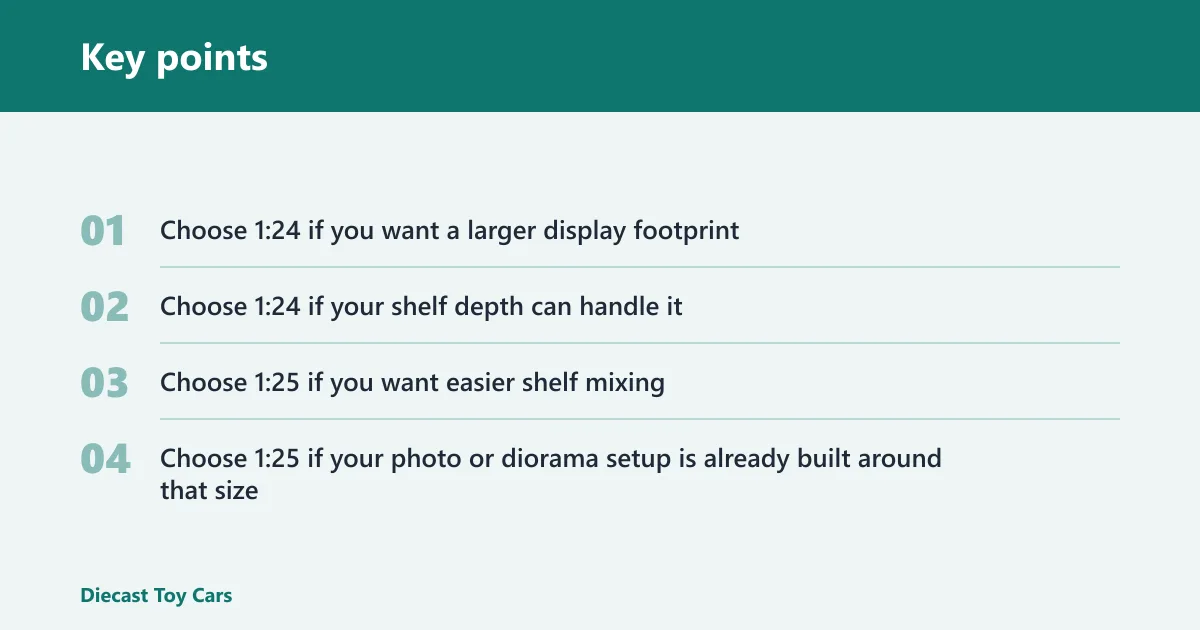
- Choose 1:24 if you want a larger display footprint. The extra size gives slightly more presence in a case and can make details easier to read at arm’s length.
- Choose 1:24 if your shelf depth can handle it. Long-bodied cars and trucks will claim a little more space, especially when mirrors or roof accessories are fitted.
- Choose 1:25 if you want easier shelf mixing. It is common in diecast, and it often pairs more naturally with other 1:25 models already in a collection.
- Choose 1:25 if your photo or diorama setup is already built around that size. Matching figures, doors, and garage props stay more consistent when every vehicle uses the same ratio.
If your collection already mixes both, use the body style as the deciding factor. A 1:24 full-size truck beside a 1:25 subcompact can feel less distracting than two near-identical coupes with different labels. The closer the vehicles are in shape and color, the more the scale gap tends to stand out.
Frequently asked questions
What is the difference between 1:24 and 1:25 scale?
The difference is a 1:24 model is slightly larger than a 1:25 model. In linear dimensions, the gap is 4.17%. That means the same full-size car will produce a 1:24 model that is a bit longer, wider, and taller than its 1:25 version.
How much bigger is 1:24 than 1:25 scale?
1:24 is about 4.17% bigger in linear size. The actual inch difference depends on the vehicle length. For a 174-inch compact car, the gap is about 0.3 inch. For a 210-inch pickup or SUV, it is about 0.35 inch. Longer vehicles show the difference more clearly.
What does 1:25 scale mean on a diecast car?
It means the model is one twenty-fifth the size of the real vehicle. If the prototype is 200 inches long, the model works out to 8 inches long. The same ratio applies to the width and height, so the whole body shrinks by the same proportion.
What size is a 1:24 scale car in inches?
There is no single fixed inch length for 1:24, because the real vehicle length sets the result. A 174-inch car becomes 7.25 inches, a 194-inch sedan becomes 8.08 inches, and a 210-inch pickup or SUV becomes 8.75 inches. The prototype length determines the final model size.
Will 1:24 and 1:25 cars fit the same display case?
Often they will, especially in general-purpose cases and open shelving. The difference is small enough that many collectors mix them on one shelf. Tight cases are another matter. If the fit is already close for 1:25, a 1:24 truck or SUV may need more clearance.
Which scale is better for collectors, 1:24 or 1:25?
Neither is universally better. Pick 1:24 if you want a little more shelf presence and do not mind the slightly larger footprint. Pick 1:25 if you want easier display mixing and a scale that is widely used for diecast cars. The better choice depends on space and consistency.